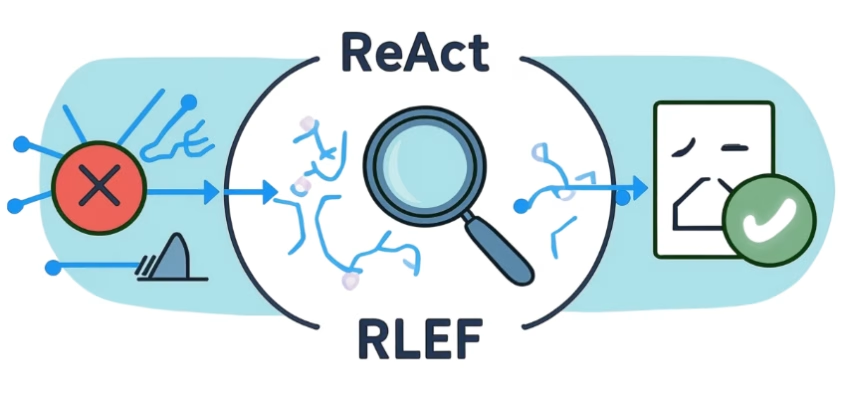
This is the fourth episode in a series on this blog that deals with AI fundamentals in combination with SAP Business One. Up to now, it has mainly been about what a language model learns before it is even used: human ratings, trial and error, and the step-by-step checking of intermediate results. This episode reverses the perspective. It is about what happens while a model is already working, using a tool or having code executed, and how it reacts to what actually comes out of it. Two methods are at the centre that sound more similar than they actually are: ReAct and RLEF.
Read MoreGMP standards for ERP in the pharmaceutical industry
Good manufacturing practice (GMP) is a system designed to ensure that products are consistently manufactured and controlled according to quality standards. It was developed to minimise the risks associated with any pharmaceutical production that cannot be avoided by testing the product.
Read MoreERP solutions for make-to-order production
ERP systems in production are usually used to map and optimise processes with large key figures. No less relevant, but much more complex, are the requirements that make-to-order manufacturers have for software.
Read MoreBPM: tool or concept?
Business Process Management - BMP for short - is basically nothing more than process management. Its tasks were often integrated as tools in ERP systems. To the frustration of users. After all, BMP is more of a concept than a tool for monitoring business processes.
Read MoreProcess optimisation in the ERP solution: Always a new system necessary?
Particularly with ERP systems that have been in use for a long time, it becomes apparent over time that some work processes still need to be improved. However, a new system is not necessarily required for process optimisation. The process analysis can be carried out independently of the ERP system anyway. The challenge - as is so often the case - lies in the implementation. The data structures in particular play a major role in process optimisation - and these are ultimately the heart of every ERP system. But how can these be changed and improved in such a way that the necessary process optimisation can be implemented?
Read More