The outgoing payment is a central step in the SAP Business One procurement process. It is used to settle liabilities to suppliers or other creditors. A corresponding outgoing payment document is created, which documents the payment and automatically triggers journal entries.
Function and meaning:
- Last step in the document chain of the purchasing process.
- Based on open incoming invoices and unallocated incoming credits.
- Creation of a separate document type in the system for outgoing payments.
Supported forms of payment:
- Cash
- Cheque
- Credit card
- Bank transfer
- Change
Creation and editing:
- Access via bank processing → Outgoing payments.
- Supplier is preselected, open items are displayed at line level.
- Partial payments and discounts can be entered manually.
- Journal entries are generated automatically.
Special functions:
- Outgoing payment on the basis of a exit credit - Automatic clearing of journal transactions.
- Creation of outgoing payments for several G/L accounts.
- Cheque allocation: Several cheques can be assigned to different G/L accounts.
- Number path replication: New voucher uses the same payment method as the previous one.
Payment methods and assistants:
- Separate tabs for each Payment method in the payment window.
- payment assistant enables collective processing of several payments.
- Requires prior maintenance of payment methods in the business partner master record.
Special cases:
- payment on account: Prepayment via checkbox "Payment on account" in the voucher window.
- Parked payments: Payments can be saved temporarily; special report available.
- Bank charges: Can be booked automatically.
- Payment blocks: Configurable in the business partner master record.
- Foreign currencies: Exchange rate gains/losses are recognised automatically.
Integration:
- Link to incoming invoice and G/L account determination.
- Relevance in the cost accounting when integrating cost centres or projects.
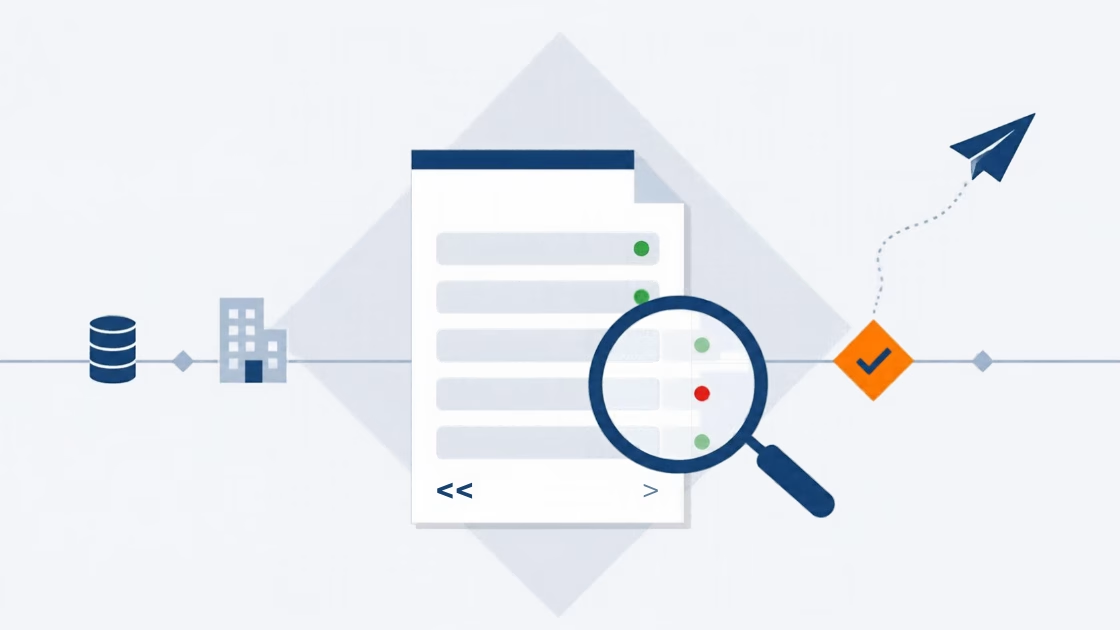
E-Invoice check by Versino Financial Suite
An e-invoice is quickly generated. SAP Business One includes the XRechnung feature as standard, and those who use cks.eINVOICE or the ...
Versino accounting service
Bookkeeping should run quietly. Vouchers come in, are posted, the VAT return goes out, and the tax advisor also gets a ...
Cash flow planning in SAP Business One: What the Versino Financial Suite does differently
Cash flow planning is considered a done deal in many medium-sized companies. After all, there are bank statements, there are open items, ...
Two free webinars in July: Experience the Versino Financial Suite live
In 90-minute sessions, we'll show you practical ways to harmonise, streamline and automate your accounting in SAP Business One….
E-Invoicing 2026: What is changing now for SMEs and SAP B1 users
The e-invoice has moved beyond the theoretical IT project phase. Since January 2025, the obligation to receive e-invoices applies to all domestic companies — ...

Netting in SAP Business One: What makes the Versino Financial Suite different
When a business partner is both a customer and a supplier, that sounds like a comfortable situation. You know each other, you trust...
