On B1if Scenario is the configuration and deployment unit in integration Framework for SAP Business One A scenario bundles everything needed for a specific integration case: triggers (what initiates the processing?), inbound adapters, processing steps, transformations, outbound adapters, and error handling. A scenario is deployed to the scenario database and subsequently runs on the B1if server, typically a Tomcat process within the SLD environment.
Context
A scenario is in the web interface cfg.biz:.scn.prc well-maintained. Each scenario has a Scenario package (sld/Scene), a version number and an activation status. Typical use cases: automatic transfer of customer orders from a shop to SAP B1, export of open invoices to factoring software, synchronisation of item master data with a master data system, PEPPOL dispatch of electronic invoices, integration with DATEV or a CRM platform. One scenario carries a Inbound-page (e.g. HTTP POST from outside, file in a folder) and a Outbound-Page (Call Service Layer, DI API, Email, further REST target); in between are processing steps with XSLT transformations, validations and branches. Faulty messages are stored in the BizStore and managed via Message Monitoring.
Demarcation
A B1if scenario is not a add on and no standard integration – it's custom integration code in XMLXSLT form that runs on B1if resources. It is also not identical to a SAP Document and reporting Compliance-Connector or the Electronic Document Management (EDS): These are SAP standard services, B1if scenarios are the generic toolbox for building your own integrations, often in combination with EDS. Compared to pure service layer integrations, B1if offers persistence, retry, asynchronous processing, and a monitoring UI – this comes at the cost of increased development and maintenance effort.

AI in everyday work: Here's how to find the right start

AI assistant meets SAP Business One: Two paths out of the Versino AI shop

Sprint and Swirl: How an AI agent divides work and learns from trials
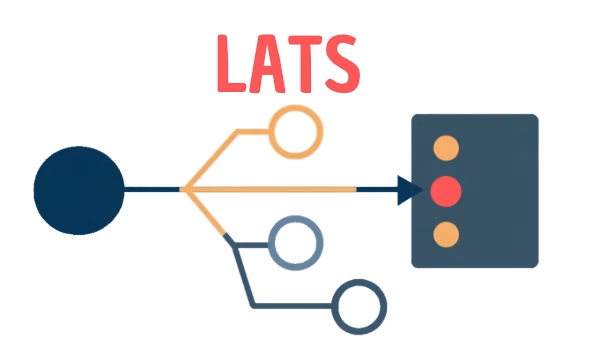
LATS: Considering several paths simultaneously with AI — and the availability check in SAP B1

ReAct and RLEF: How Artificial Intelligence Learns from Real Mistakes — and What Automated Bank Reconciliation in SAP Business One Has to Do with It