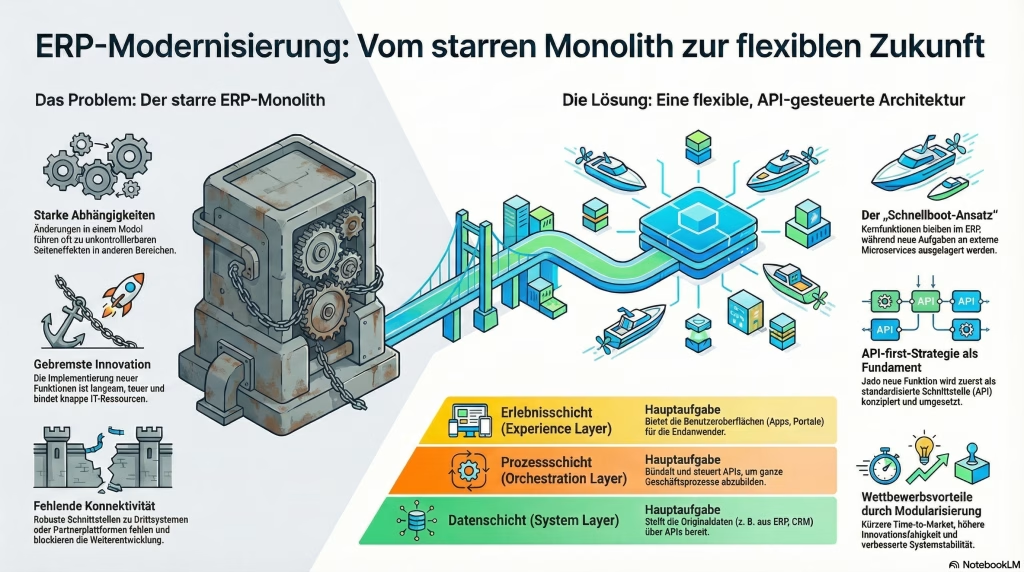
Many medium-sized companies still work with ERP monoliths that have grown over the years. The modules of these systems are closely interlinked, which is why changes in one area often have a direct and unexpected impact on other areas. This results in side effects that are difficult to control and noticeably slow down projects. However, the solution is not to replace the monolith, but to modularise it step by step: Via a API-first strategy, external Microservices, The ERP core is decoupled, supplemented in a targeted manner and progressively relieved - without jeopardising ongoing operations - thanks to a clear three-tier architecture and hybrid integrations in cloud platforms.
Although new functions can be technically integrated, this takes a lot of time and ties up scarce capacities. In addition, there is often a lack of robust interfaces to third-party systems or they are only available in a rudimentary form. This is why necessary expansions are repeatedly postponed, even though the pressure to modernise is increasing. It is precisely at this point that it becomes clear that „business as usual“ is no longer an option; the ERP monolith needs a new role in the IT landscape.
Modularisation instead of system demolition
Instead of radically replacing the monolith, there is a strategic approach: Modularisation. The aim is not to replace the existing ERP core, but to decouple it in a targeted manner and supplement it in a meaningful way. As a result, ongoing operations remain stable while new requirements are covered at the same time.
The speedboat approach in practice
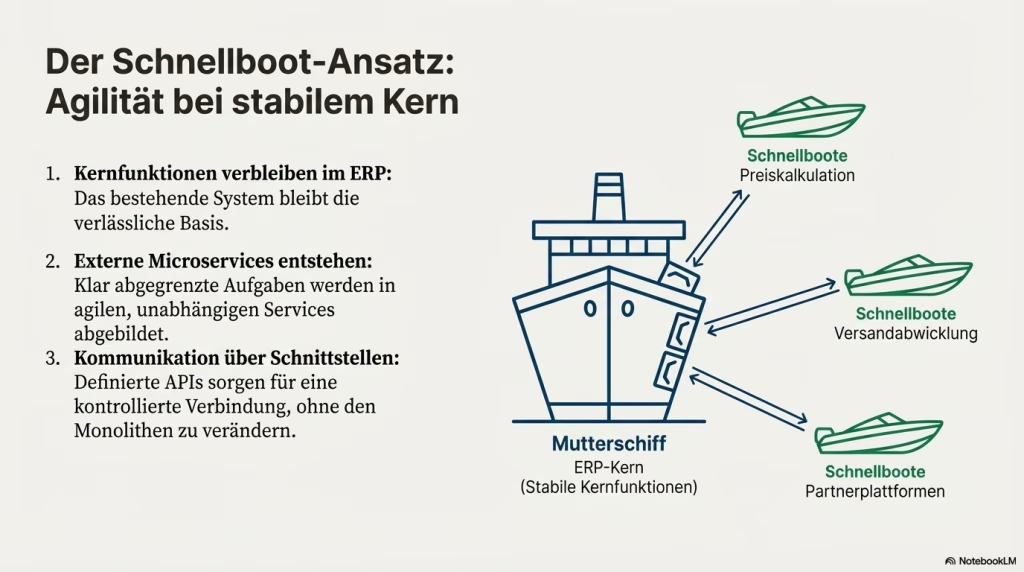
A tried and tested approach is the so-called speedboat approach. The central core functions of the ERP remain in the existing system. At the same time, external microservices are created that take on clearly defined tasks. These include, for example, price calculations, dispatch processing or the connection of external partner platforms.
These microservices communicate with the ERP core via defined interfaces. This allows new functions to be added without having to change the Monoliths constantly having to change. Step by step, a modular landscape is created in which individual services can be expanded or replaced in a targeted manner.
Relief of the core through specialised services
By outsourcing functions, the monolith is progressively relieved. Processes that were previously deeply rooted in the core system will in future run in specialised services. This reduces the risk of adjustments in one place triggering unintended problems elsewhere. At the same time, operational stability is maintained because the ERP core continues to fulfil its role reliably.
The API-first strategy as the backbone of modernisation
Modularisation can only be implemented sustainably if a clear API-first strategy provides the framework. Every new function and every integration is therefore initially conceived as an interface - regardless of whether it is used internally or externally. The API is therefore not just a technical appendix, but the actual starting point of the design.
Key advantages of standardised interfaces
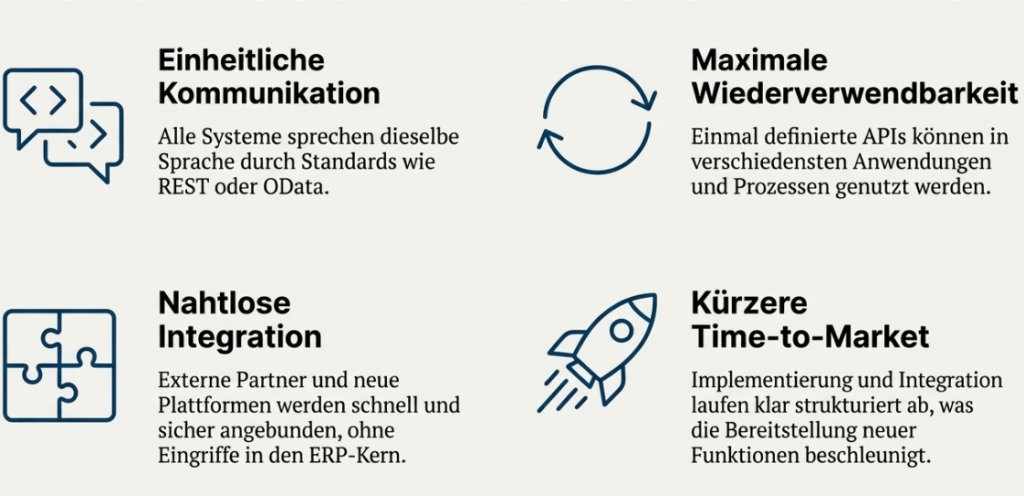
An API-first strategy has several advantages. On the one hand, standardised communication standards are created, for example on the basis of REST or OData. This means that all systems involved speak the same language. On the other hand, reusability increases because APIs can be used in different applications once they have been defined.
This approach also facilitates the integration of external partners and systems. New platforms can be connected via standardised interfaces without having to dig deep into the ERP core. As a result, the time it takes to provide new functions is reduced, as implementation and integration are clearly structured.
Practical example: ERP modernisation via an API hub
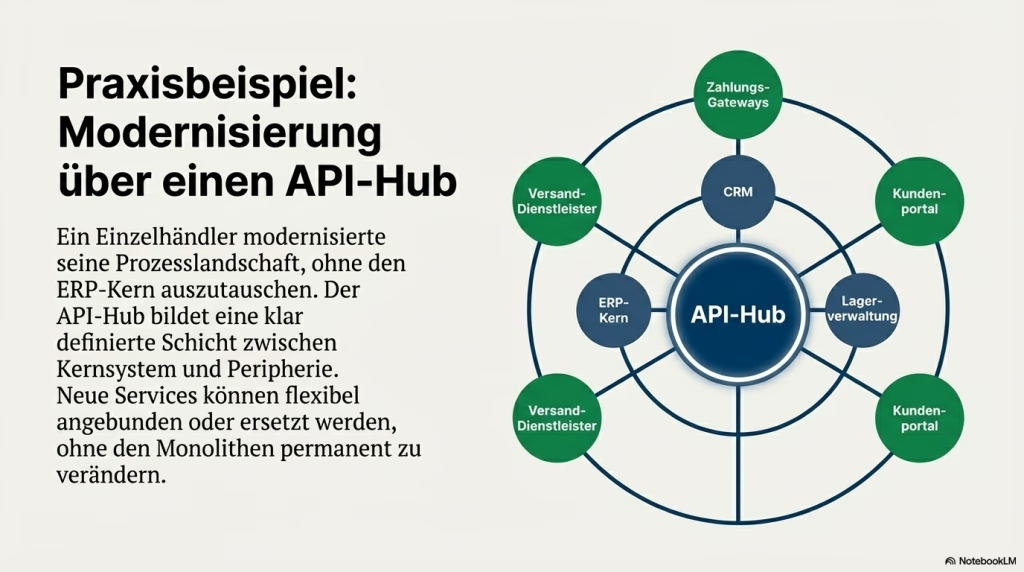
An illustrative example is provided by a retailer that did not replace its ERP core but modernised it via an API hub. Internal systems such as CRM, warehouse management and accounting were connected via this central hub. At the same time, the hub connects external services for Shipping, payment and customer portals.
This enabled the company to expand its process landscape without having to intervene deeply in the ERP system. The APIs form a clearly defined layer between the core system and the peripherals. New services can therefore be connected or existing ones replaced without permanently changing the monolith.
Three-layer architecture for structured decoupling
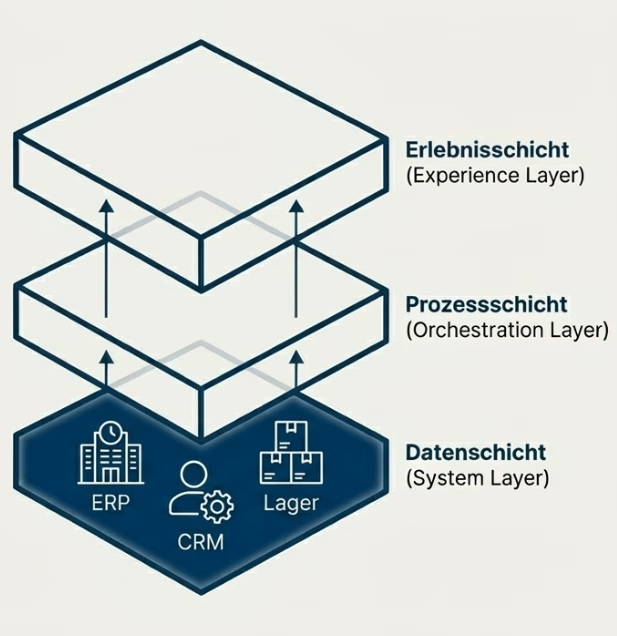
To ensure that the growing system landscape remains clear, it is advisable to set up a three-tier architecture. This structure separates data storage, process logic and user experience. This creates a clear division of tasks between the levels.
Data layer (system layer)
The data layer contains the original data, such as customer master data, stock levels or invoice data from the ERP system. This layer provides the authoritative database. Therefore, each additional layer accesses this information via defined interfaces instead of duplicating it.
Process layer (orchestration layer)
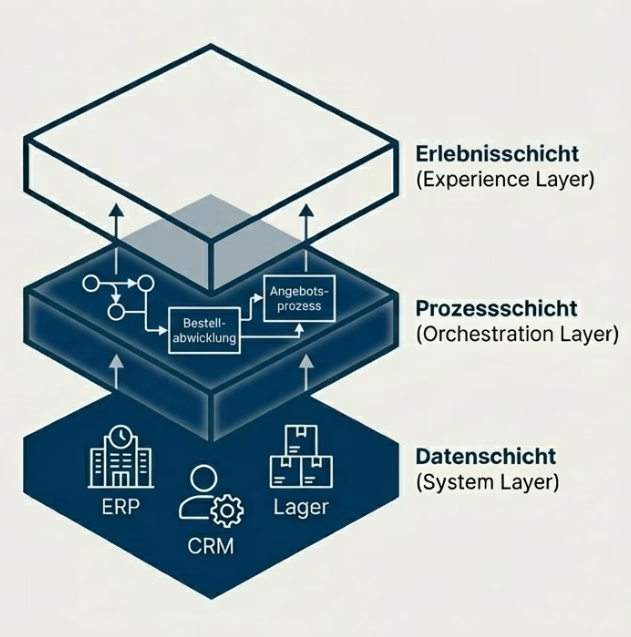
The process layer bundles APIs to map complete business processes. These include, for example, quotation submissions, Order processing or complaint processes. In this layer, individual services are orchestrated and linked to form end-to-end processes. This keeps the processes flexible while the database remains stable.
Experience Layer
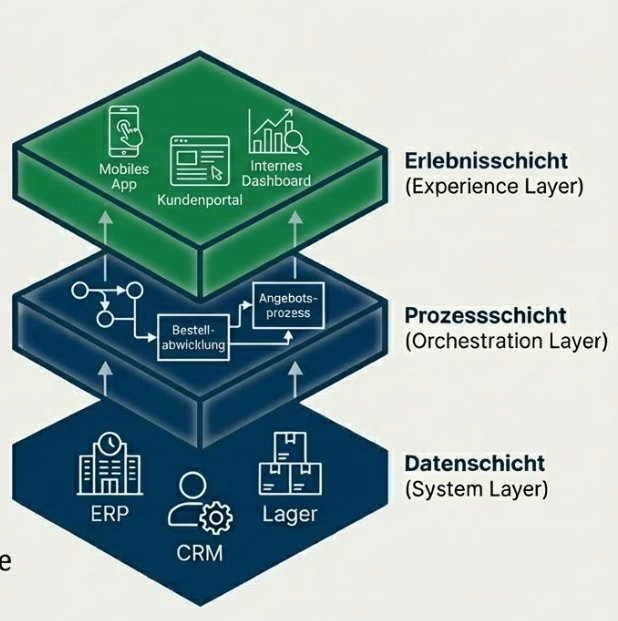
Interaction with users takes place in the experience layer. This includes dashboards, self-service portals and mobile apps. Changes to the user interface therefore do not directly affect the ERP system. Instead, they utilise the processes and data that are provided via the lower layers. This enables standardised further development, even though the IT landscape is becoming more complex overall.
Gradual integration of cloud technologies
A modernised architecture does not have to move completely to the cloud. Hybrid models are often an option, in which parts of the system continue to be operated locally, while new functions can be implemented via the cloud. cloud-platforms can be added. This means that control over existing core systems is retained, while modern services can be utilised at the same time.
Making sensible use of hybrid models
In a hybrid scenario, the on-premise ERP continues to take on central tasks such as master data management and core accounting. Supplementary functions such as integrations to online platforms or external services, on the other hand, run in the cloud. The connection is again made via APIs and integration platforms. The cloud share can therefore be increased step by step without risking a big-bang change.
Many cloud-based integration solutions provide predefined connectors for typical business applications. This significantly reduces the effort required to connect external systems. Updates are carried out in the cloud without the need to adapt local components. At the same time, the integration logic remains centrally controllable so that new services can be integrated more quickly.
In addition, these platforms often facilitate the integration of third-party systems, for example from the areas of e-commerce, customer service or payment processing. The resulting hybrid architecture thus combines the stability of existing core ERP systems with the flexibility of modern cloud services.
API governance: guidelines for sustainable success
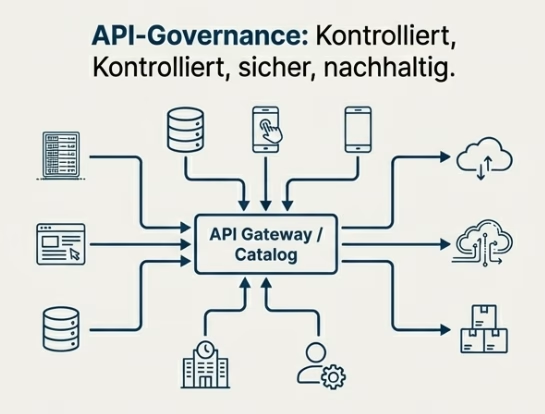
The complexity of the landscape grows with every new API. This is why consistent API governance is essential. It ensures that interfaces are not created in an uncontrolled manner, but are designed and operated according to clear rules.
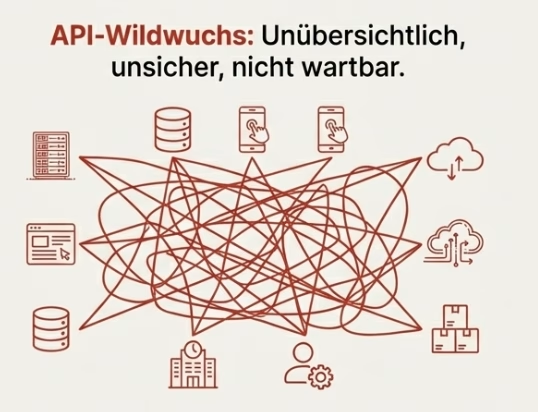
Such governance includes central administration and cataloguing of all APIs as well as versioning and deprecation management. In addition, access and security guidelines define who is authorised to use which APIs and how. In addition, monitoring and logging ensure that errors and anomalies become visible.
Without these guard rails, there is a risk of „API proliferation“. As a result, the overall system would be more difficult to manage in the long term than the original monolith. This is why governance is not an optional appendage, but an essential component of architecture modernisation.
Architectural modernisation as a competitive factor
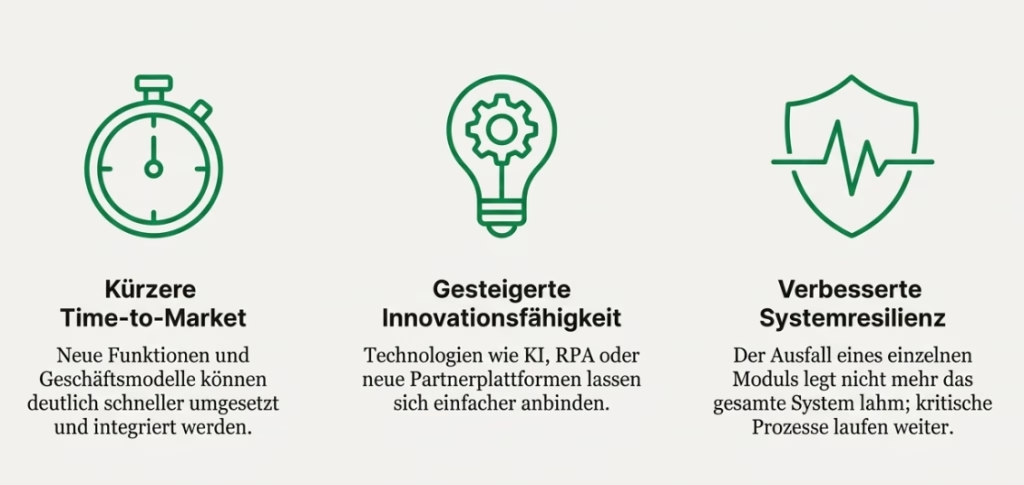
Switching to a modularised ERP architecture is more than just an IT project. It has a direct impact on a company's competitiveness. The time-to-market is reduced because new functions can be integrated more quickly. In addition, the ability to innovate increases as technologies such as AI, RPA or external platforms can be connected more easily.
At the same time, system resilience is improved. If a single module fails, the entire system no longer has to come to a standstill. Instead, other parts of the landscape can continue to work. Above all, however, a flexible ERP environment is created that can react to changes without jeopardising the stable operation of the core. This is precisely what transforms a once rigid monolith into a future-proof backbone for company processes.

AI assistant meets SAP Business One: Two paths out of the Versino AI shop

Sprint and Swirl: How an AI agent divides work and learns from trials
LATS: Considering several paths simultaneously with AI — and the availability check in SAP B1

ReAct and RLEF: How Artificial Intelligence Learns from Real Mistakes — and What Automated Bank Reconciliation in SAP Business One Has to Do with It
SAP B1 10.0 FP2608: Service Layer AI as a transactional layer