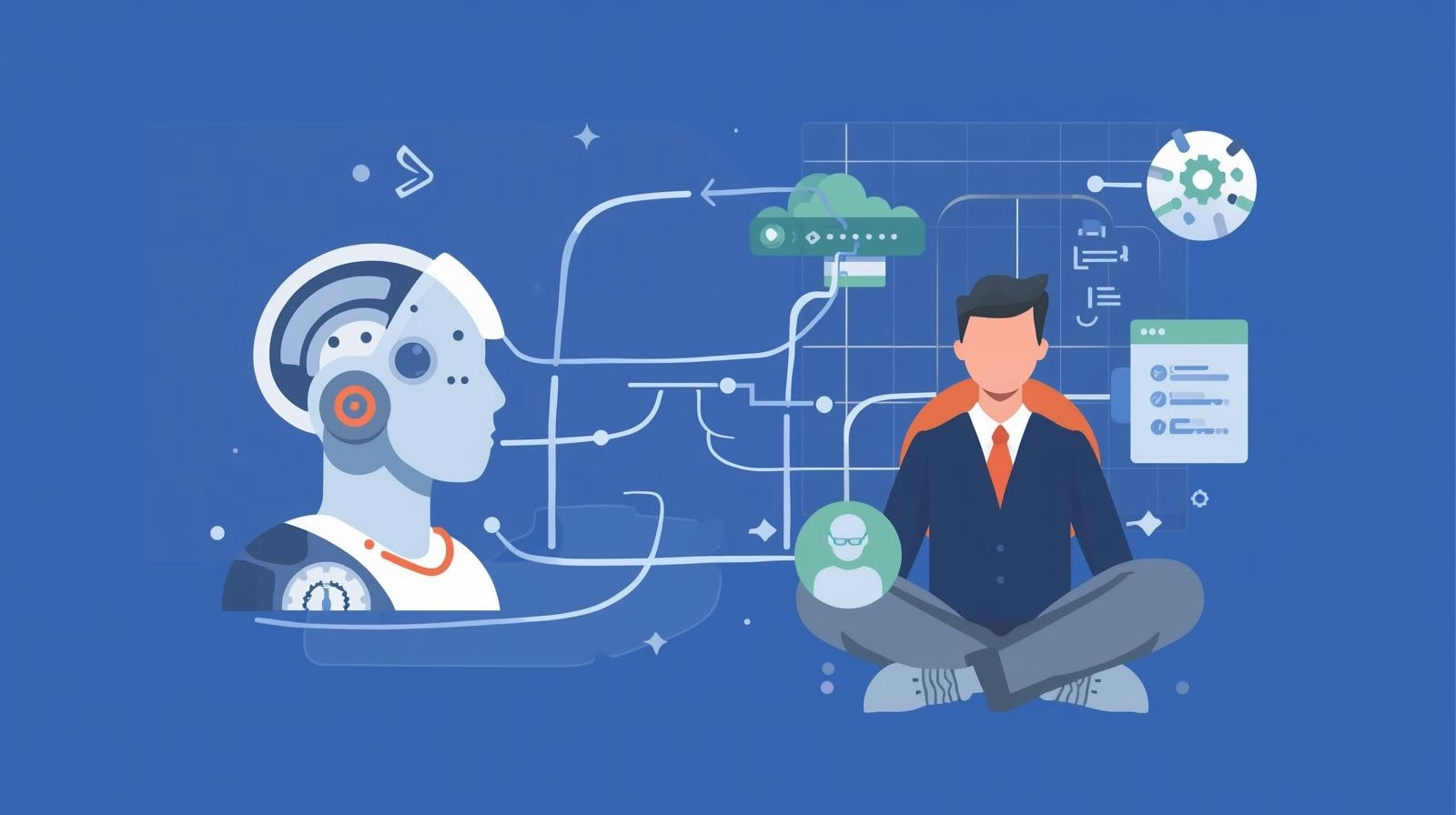
The Model Context Protocol (MCP) is an open standard that allows AI assistants and language models to access external data sources and tools. Anthropic released MCP in November 2024 and made it available as an open-source project. The standard regulates how a language model sends a request to a database, a file system or an enterprise system and receives the response back in a structured format. This means a language model no longer needs to be specially customised for every single data source.
The architecture follows a client-server model. An MCP server provides data or functions, such as access to a CRM, a calendar or a database. An MCP client, embedded in an AI application, connects to this server and retrieves the provided functions. Before MCP, a separate connection had to be programmed for every combination of AI application and data source. MCP replaces this multitude of individual solutions with a common protocol, much like a USB socket serves different devices via the same connection.
MCP in the SAP Business One context
For SAP Business One, MCP is relevant as soon as an AI assistant needs to access live business data, such as open items, item stock levels or document data via the Service Layer or the DI-API. Instead of building a separate interface for each type of request, an MCP server provides the relevant B1 functions once. Any MCP-enabled client, whether a chat interface or developer tool, can access it.
Demarcation
MCP is not a replacement for the service layer or a REST API. It sits rather as a layer above that: MCP standardises how an AI model calls such interfaces, not how the interface itself is built. Compared to retrieval-augmented generation, MCP covers a different need. RAG retrieves text knowledge from a knowledge base, whereas MCP gives the model access to structured data and executable functions.
SAP B1 10.0 FP2608: Service Layer AI as a transactional layer
Process Reward Models: Why a correct result does not yet prove a correct method

Test-Time Compute Scaling: Why a Smaller AI Model Can End Up Winning — and What Supplier Comparison in SAP Business One Has to Do With It

RLHF and reward models: The reality behind the AI hype — and what the approval process in SAP Business One has to do with it

AI – Answers from SAP Business One – without SQL, without IT ticket