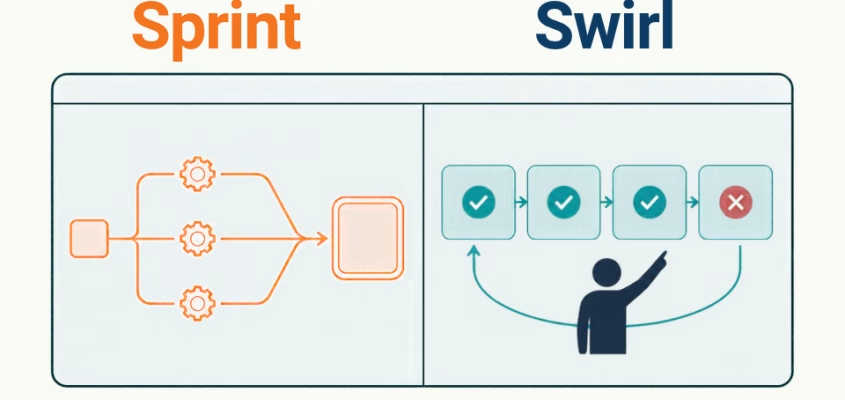
This series deals with artificial intelligence in conjunction with SAP Business One. It takes a close look at fundamental AI principles and reflects them on an example from everyday ERP use. The previous post about LATS The example showed how a model thinks through several paths when responding at the same time. This time it concerns two methods that are used earlier. Sprint and Swirl no longer give a language model time to think through its responses. They already teach it a way of working during training. One learns to perform partial steps simultaneously. The other learns from recorded trials. And here too there are already approaches in SAP Business One that can be adapted.
Read more: Sprint und Swirl: Wie ein KI-Agent Arbeit aufteilt und aus Probeläufen lerntOne after the other
Those who get one thing done after another work methodically. That’s how you learn it in training, and most of the time it’s also correct.
That’s the ideal world. Those who faithfully follow every step after the previous one often wait for their own success. The offer request to Supplier B is not affected by what Supplier A has replied. Still, it often remains unanswered until A has responded. And those who learn only from real mistakes pay for every one of them in the ongoing operation.
The same applies to language models. A language model writes its answer word by word, one after the other. For a simple question, this is quite sufficient. With a task involving many steps, this way of working becomes a bottleneck. Each step waits for the previous one, even though it may not be needed at all. The model then calculates partial tasks in succession, which could easily be done simultaneously.
Two questions that every project manager knows the answer to
This applies especially to programs that, for example, create queries, compile numbers, or perform calculations. Such an agent faces the question of what can be done simultaneously and what has to wait. At the same time, the question arises of where to practice the model before it runs in the real system.
Such questions are usually asked of the project manager. Research therefore does not bring any new capability to language models here, but rather to work organization. One method learns to recognize and process independent sub-steps simultaneously. The other learns from evaluated trials that it has previously recorded. Everyone who has ever led a project knows this. What is new is that a machine learns it itself.
A large kitchen and an apprentice
A chef is planning a menu for a celebration. The potatoes are boiling while the sauce is reduced. A colleague is preparing the dessert in the meantime. The chef only starts cooking when all the ingredients are ready. The real art lies not in the cooking. It lies in knowing what can go together at the same time and what has to wait. The sauce needs the braising time, so it comes after the meat. The potatoes need nothing but water and time.
In the same kitchen, an apprentice is learning. He is not practicing on the evening of the booked wedding celebration. He is practicing on recorded practice runs. The instructor goes through these recordings and evaluates each individual move. The plate has not been successful at the end of the practice run does not play a role in this evaluation. A practice run with clean hand movements remains instructive, even if the sauce has burnt on at the end.
The head chef is responsible for the Sprint method, and the apprentice for Swirl. Both methods help a language model organize work. The next section shows how this works technically.
How a model learns to organize work
Two ways to better answers
A language model can be improved in two ways. The first way involves responding to questions. The model gets more computing time and searches through many possible paths before deciding on a solution. This is how LATS works from the previous post. The second way involves starting earlier, namely during training. There, the model learns a structure that it later applies on its own.
Sprint and Swirl belong to the second type. They use two well-known learning methods. In supervised fine-tuning, a model learns based on pre-defined examples, comparable to a cook apprentice who replicates the dishes of his master. In reinforcement learning (learning through reward), the model tries something out (in the experimental kitchen) itself and receives feedback for each action. Good actions strengthen it, while bad ones make it less likely in the future. Both methods generate their own training data, rather than having people write it.
Sprint: independent steps at the same time
Sprint comes from research work „SPRINT: Enabling Interleaved Planning and Parallelized Execution in Reasoning Models“ from the year 2025. At its core is a so-called DAG (Directed Acyclic Graph). That sounds more complicated than it is. It refers to a map of dependencies: which thought step needs which other step? Steps without mutual dependence form parallel paths, like potatoes and dessert in the kitchen. The process takes place in three phases:
- Preparing data: A large language model takes the long, detailed thought processes of a powerful model and breaks them down into individual steps. It identifies which part is planning and which is execution, and from this it derives the map of dependencies.
- Fine-tuning: A basic model learns by supervised fine-tuning on these prepared examples. It learns to assign independent plans simultaneously, each with its own label.
- Application: With a new question, the model generates several independent plans at once. These run in parallel, for example as tool calls or calculations. The results are then collectively returned to the context. This is followed by a new plan round or the final answer.
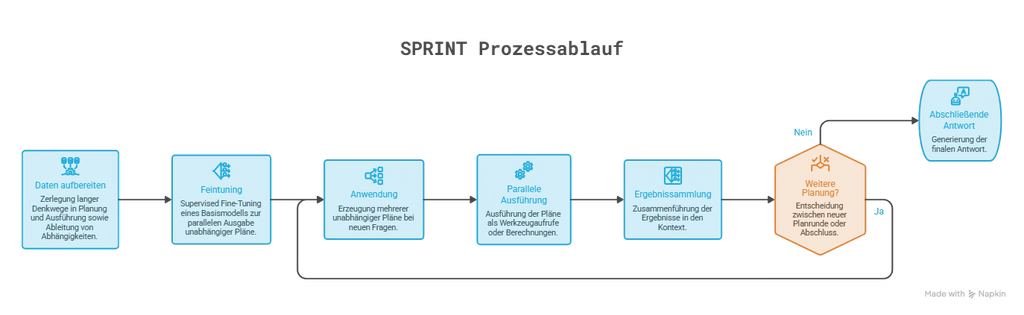
What is crucial is the third phase. The model does not plan at the beginning and then rigidly proceeds with execution. It switches back and forth between planning and execution. After each parallel round, it knows more and plans the next round based on this information.
Swirl: learning from experiments
Swirl stands for Step-Wise Reinforcement Learning, which means gradual learning through reward. The method originates from research work. „Synthetic Data Generation & Multi-Step RL for Reasoning & Tool Use“ from the year 2025. It runs in four phases:
- Run tests: The model processes a question step by step. Each step consists of a thought process and a tool call, such as a search or an invoice. The tool actually runs during the training phase, but in a separate training phase. A second language model judges each step. The judge does not know the result of the tool call.
- Filter data: The evaluated trials generate various training datasets. The process-filtered dataset contains runs whose individual steps are well-evaluated, just as the final result is. The result-filtered dataset contains only runs with a correct final result. A third requires both, a fourth randomly selects one.
- Training without running tools: The model gets a snapshot of a trial run and suggests the next step. The reward for this is the training data from the previously stored evaluations. No tool has to run again for this.
- Application: In use, the model calls up its tools itself, step by step and only when necessary.
The key lies in the separation. Probing and evaluation are done in advance. The actual learning then only relies on these recordings. A previous post in this series described this with ReAct and RLEF, Like Artificial Intelligence that learns from real mistakes. Swirl, on the other hand, learns from recorded errors and successes.
Process Rewards: the second appearance
An earlier post in this series has dealt with Process Reward Models employed. There was a question there about whether a correct result also proves a correct path. Swirl takes this question a step further. Is a run with a false final result suitable as learning material if its individual steps were good?
The answer depends on the learning method. When learning through reward, the process-filtered dataset performs better than the outcome-filtered one, and also better than the combined one. Swirl therefore explicitly learns from runs that end up being wrong. The reasoning is surprising at first, but it makes sense. Runs with a correct result only show what the model is already capable of. However, learning should be about the tasks on which it currently fails. With reward learning, it gets a new chance at every individual step. This way, it learns to break out of a flawed overall process.
In supervised fine-tuning, the opposite is true. Those who imitate also imitate errors. In this case, the model needs runs where the path and result are correct. Runs with incorrect results can even harm it. Overall, the gradual learning via reward significantly outperforms imitation.
What connects the two
Both methods exhibit a property that goes beyond better planning. They transfer the learned knowledge to tasks that did not even occur during training. The technical term for this is out-of-domain generalization.
Sprint learned parallel thinking exclusively through math problems. With two other types of tasks he had never seen in training, he also worked in a more parallel and precise way afterwards. Swirl learned with calculating tasks using a calculator and subsequently became better at research tasks using a search tool. Conversely, the quality of the individual steps also increased within and outside the training tasks.
The model apparently learns more than just how to use a specific tool. It learns to think in steps and to call up tools specifically. This is work organization in the truest sense of the word.
Planning in SAP Business One: the principle without learning
SAP Business One has several planning tools. For example, part projects or the Disposition Assistant can be considered exemplary. One of these belongs to project management, the other to material requirements planning. Both organize work according to a similar pattern to sprints and swirls. However: Neither of them learns anything in the process.
Subprojects: disassemble, work side by side, combine
in the project management With SAP Business One, a project can be divided into subprojects on a separate tab. In the main project, budget and profit appear cumulatively, that is, as a sum over the subprojects. This is similar to the process that the sprint goes through in the application phase: break down a large task into smaller parts, work on them side by side, and then combine the results.
The comparison ends at three points:
- The human being determines which subprojects exist when creating the project. Sprint, on the other hand, learns to recognize the dependencies between the steps themselves.
- Simultaneity is organizational in SAP Business One. Teams work side by side; the system does not compute in parallel.
- The accumulation in the main project is a final stage. After it, no new planning round begins, as Sprint does after each meeting.
The disposition assistant calculates and lets you decide
In the Material Requirements Planning The Disposition Assistant calculates the needs. It operates separately from the day-to-day business and stores its results as a proposal. Only in the order recommendation does the dispatcher review these proposals. He or she adapts them and, if necessary, converts them into orders with suppliers or into production orders.
This is the separation that also characterizes Swirl: first calculating and storing, later checking and using. The calculation takes place once. Subsequent use draws on the stored result.
Here too, the comparison ends significantly. The disposition assistant does not evaluate each individual calculation step. It does not sort its suggestions according to the quality of the path or the result. And it does not learn from what the dispatcher does with a suggestion. Both tools organize planning. Neither of them learns from it.
Thought experiment: Planning that learns from one's own suggestions
What follows is a thought experiment, not an announcement. The described extension is not yet available in SAP Business One, but is certainly conceivable with artificial intelligence.
Subprojects that recognize their own dependencies
When creating a new project, a learning component suggests a structure. It draws from previous projects which sub-tasks can run independently and which must wait for one another. The assembly is waiting for delivery; the training of the users is not necessarily a priority. The project manager sees the proposal as a map of dependencies and decides what to take on. After each completed section, the component compares the plan with the actual status and proposes the next round, in full accordance with the sprint principle.
Disposition that learns from the archive of their suggestions
Suppose the system adhered to every order recommendation, which is what the dispatcher did: accepted, modified, or rejected. Such an archive would be a collection of trials in the sense of Swirl. A judge-like authority would evaluate each planning step individually, such as an assumption regarding the delivery time or the order quantity. The later stock level alone does not determine whether something is good or bad.
The learning process takes place offline, without touching the ongoing client. The lessons learned from Swirl apply here as well: Even a proposal that ultimately led to a bottleneck contains good individual steps. The component learns from these steps, rather than discarding the entire proposal. The dispatcher thus receives suggestions that are a little better suited to his operation with each planning round.
The catch
As always, there are pitfalls and obstacles that must be taken into account. The first risk lies in the coordination process. A misconstrued sense of independence leads to conflicting parts of the plan being implemented simultaneously. The coordination system only notices what it sees. Two subprojects that access the same resource without being noticed first appear when it is too late.
The second risk lies with the judge. He assesses a step without knowing its outcome. A seemingly plausible but incorrect planning step may therefore receive a good grade. A repository full of such notes then leads the system to assign the wrong grade with great care.
Who it's worth it for
This post is aimed at anyone who wants to understand why an AI agent is more than just a faster text output. It refers to a program that organizes its own work.
Anyone who does not use project management or material requirements planning in SAP Business One will find little relevance to their own practice in the example. He can nevertheless take away the clarification of the terms sprint and swirl. This text provides clarity on terminology, not a decision-making template.
Good project managers and dispatchers have always been able to work and learn from trial and error. What is new is that a model learns from data in this way, instead of being told in a case-by-case manner. However, there is no way around this: someone has to tell the judge what a good step is. If someone does not know this for their own processes, no machine will teach them.

Sprint and Swirl: How an AI agent divides work and learns from trials
LATS: Considering several paths simultaneously with AI — and the availability check in SAP B1

ReAct and RLEF: How Artificial Intelligence Learns from Real Mistakes — and What Automated Bank Reconciliation in SAP Business One Has to Do with It
SAP B1 10.0 FP2608: Service Layer AI as a transactional layer
Process Reward Models: Why a correct result does not yet prove a correct method