
the Replenishment days — often referred to as lead time — in SAP Business One is the number of days a supplier typically needs to deliver an item after ordering, or that your own company allocates for the production of a semi-finished or finished product. They are a central planning parameter: without them, neither MRP runs can generate timely purchase proposals, nor can realistic delivery dates be communicated to customers.
Context
The replenishment days are in the item master on the tab Planning data Field Lead Timestored and have a system-wide effect. In the MRP run, SAP Business One calculates backwards from the requirement date using this time and determines the latest possible order date. Via the report Display orders with exceeded item lead times can orders be identified whose delivery date is beyond the defined replenishment lead time — a common warning sign for delayed deliveries or incorrectly maintained base data. In operative practice, fixed procurement days are often supplemented by Safety days or a safety stock to buffer fluctuations in supplier performance. In combination with order intervals (cycle code) and minimum order quantities, the replenishment lead times form the basis of MRP-based procurement.
Demarcation
Reorder days are an item attribute, not a vendor attribute — if lead times vary greatly between vendors, this needs to be mapped via alternative vendors with different reorder entries or custom logic, as a single item in SAP B1 only carries a standard lead time. They are also not identical to the Minimum range or the Returns logged, the stocks and not controlling times, and not to be equated with the lead time a manufacturing order, which over the work schedule is calculated individually.

AI in everyday work: Here's how to find the right start

AI assistant meets SAP Business One: Two paths out of the Versino AI shop

Sprint and Swirl: How an AI agent divides work and learns from trials
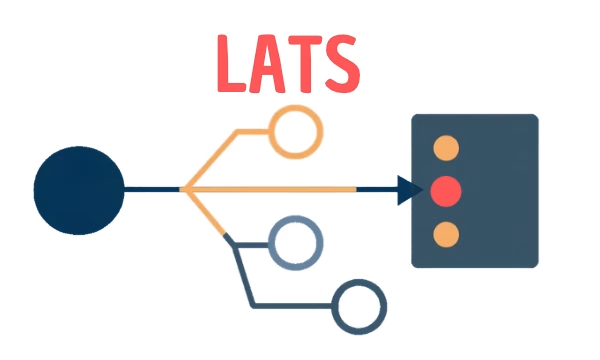
LATS: Considering several paths simultaneously with AI — and the availability check in SAP B1

ReAct and RLEF: How Artificial Intelligence Learns from Real Mistakes — and What Automated Bank Reconciliation in SAP Business One Has to Do with It