On AI Agent is an AI system that autonomously pursues predefined goals: It plans in multiple stages, makes decisions, and performs actions. In doing so, the AI agent interacts with its environment through external interfaces and other tools. Another name for this is agentic AI.
Functionality
Generative AI systems produce content primarily reactively. AI agents, on the other hand, act proactively. They break tasks down into individual steps and adapt their approach based on feedback from the environment (reasoning). In a task such as „booking a trip,“ the AI agent queries availability, compares options, and even books a suitable flight itself. The technical foundation is predominantly composed of large language models and machine learning algorithms.
Expert glossaries break down the agentic rule system into four phases: observation, inference, action, and feedback. For action, the AI agent needs tools. The AI model is embedded in a software architecture that integrates external tools (tool usage). Typical interfaces are APIs, code interpreters, and databases. Thus, the agent uses real-time information, executes program code, or incorporates dynamic data environments. The focus thus shifts from the individual model response to the control of entire action sequences.
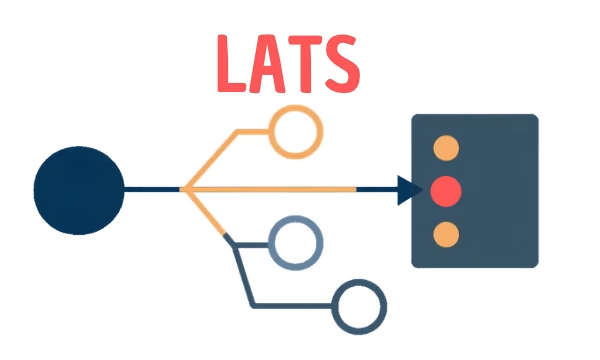
An AI agent can also maintain a memory. The Reflection process distinguishes a short-term memory for the previous history and a long-term memory for the results of self-reflection. The LATS (Language Agent Tree Search) process combines language models with a Monte Carlo tree search, evaluation functions, and self-reflection.
Autonomy and human control
The EU AI Act defines an AI system as a machine-based system that operates with varying degrees of autonomy. The higher the degree of automation of a system, the less supervision and control by humans is necessary. Expert taxonomies distinguish between remote-controlled systems, assistance systems, automated systems, and autonomous systems. For oversight, expert taxonomies describe two monitoring models. In human-in-the-loop, the human actively approves every decision. In human-on-the-loop, the human monitors the system and may intervene or terminate. Article 14 of the AI Act is titled „Human Oversight“ and is one of the requirements for high-risk AI systems.
Risks
AI agents increase automation. At the same time, the risks grow when someone misuses them. An agent can also hallucinate or plan inefficiently. In a test environment, an agent without self-reflection remained at a hallucination rate of 22 percent. Some tool prompts are difficult for humans to understand. In such cases, the agent’s self-reflections can be monitored. This allows the correct intent to be checked before the agent uses the tool.
Getting started in practice
For the first deployment, a small framework is sufficient: a single folder, read-only permissions, and a clear first question. As the agent works, concrete questions are asked from unknown parts. After that, the agent is gradually given more tasks.
Demarcation
An assistance system supports people in certain situations. The person activates the assistance system and may over-use it. An AI agent, on the other hand, pursues its own goals independently. The use in the SAP Business One environment is covered by the entry AI Agent for SAP B1. Related entries: AI Assistant; AI Agent for SAP B1; Human-in-the-Loop (AI); Reflexion (AI); Memory (AI); Large Language Model (LLM).

AI in everyday work: Here's how to find the right start

AI assistant meets SAP Business One: Two paths out of the Versino AI shop

Sprint and Swirl: How an AI agent divides work and learns from trials
LATS: Considering several paths simultaneously with AI — and the availability check in SAP B1

ReAct and RLEF: How Artificial Intelligence Learns from Real Mistakes — and What Automated Bank Reconciliation in SAP Business One Has to Do with It