Process Reward Model
Process Reward Model (PRM) is a method whereby an AI model is rewarded not just for a correct final result, but for every single step along the way. A PRM evaluates a model's calculation or reasoning path step by step and checks whether each intermediate thought is coherent.
The background: models that solve complex tasks in multiple steps sometimes arrive at a correct result by chance, even though the method used was flawed. Training based purely on the final result would reward this accidental success and thereby reinforce incorrect procedures. A Process Reward Model steps in precisely here. During response generation, it acts as a kind of evaluator that checks, discards or confirms individual steps of thought. This makes it possible to train models that not only arrive at the right result, but take a comprehensible path to get there.
This becomes practically relevant in multi-step reasoning, such as in mathematical problems, program code generation, or complex evaluations, where a single error in an intermediate step can upend the entire result. A cleanly trained PRM increases the comprehensibility of such models and reduces the risk of a model arriving at the correct result for the wrong reasons.
Demarcation
A Process Reward Model differs from Outcome-based Reward Model, which exclusively evaluates the end result and ignores intermediate steps. Process evaluation is more complex because every single step must be annotated or evaluated, but in return it provides a finer and more robust training signal. A process reward model cannot be equated with classical reinforcement learning in the stricter sense. It is a component within reinforcement learning training, specifically the reward function, not the entire learning process.
SAP B1 10.0 FP2608: Service Layer AI as a transactional layer
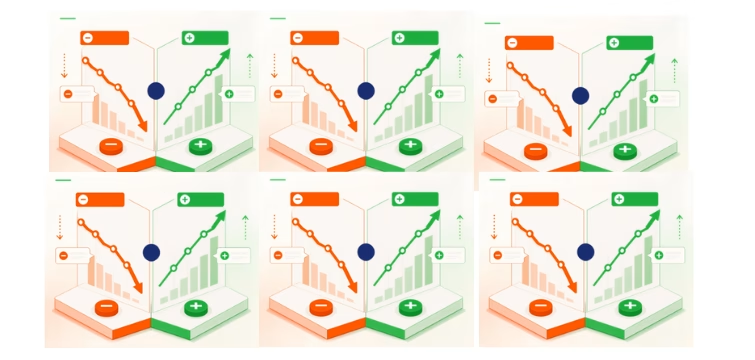
Process Reward Models: Why a correct result does not yet prove a correct method

Test-Time Compute Scaling: Why a Smaller AI Model Can End Up Winning — and What Supplier Comparison in SAP Business One Has to Do With It

RLHF and reward models: The reality behind the AI hype — and what the approval process in SAP Business One has to do with it

AI – Answers from SAP Business One – without SQL, without IT ticket