On Processing step — otherwise too Atom known as – is the smallest executable unit within a B1if scenario. It performs exactly one processing step: applying an XSLT transformation, checking a condition, executing a loop, calling an adapter, setting variables, or making a call to a service layer. Multiple atoms are linked together in a scenario to form a flow that moves a message from the inbound to the outbound side.
Context
A typical atom has an input XML, an output XML, and optional configuration parameters. Atom types include, but are not limited to: Transform (XSLT), Switch/Case Branching, Loop (Iteration over elements), Call (Call another scenario), Outbound Adapter (HTTA, WSAS, JDBC etc.), Log (Write to log), Error (explicit error triggering). The chaining takes place graphically Flow EditorThe developer drags atoms into the workspace, connects them, and saves the scenario. At runtime, a context object flows through the atoms, which holds the message payload, variables, and metadata is worn. Errors of an atom are intercepted, logged or propagated depending on the configuration; the BizStore persists every run, enabling retries and resumptions.
Demarcation
A Processing Step should not be confused with a complete workflow step as found in BPMN tools — it is more granular and technically oriented. Nor is it the same as an adapter: adapters provide transport; atoms orchestrate and transform. Compared to a single stored procedure or a REST call, the atom model with its chaining offers significantly more structure, monitoring, and reusability — at the cost of XMLXSLT-centric learning curve.

ReAct and RLEF: How Artificial Intelligence Learns from Real Mistakes — and What Automated Bank Reconciliation in SAP Business One Has to Do with It

SAP B1 10.0 FP2608: Service Layer AI as a transactional layer
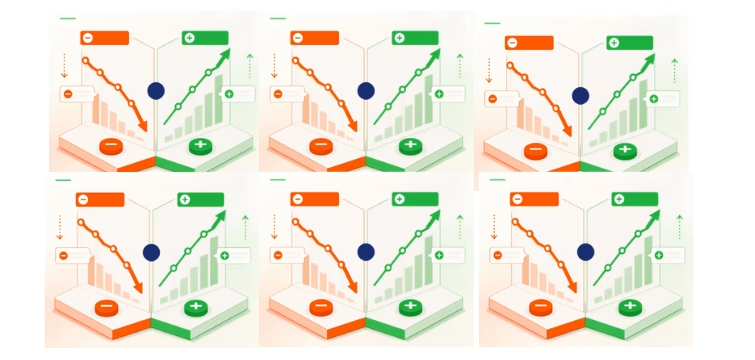
Process Reward Models: Why a correct result does not yet prove a correct method

Test-Time Compute Scaling: Why a Smaller AI Model Can End Up Winning — and What Supplier Comparison in SAP Business One Has to Do With It

RLHF and reward models: AI hype or what the approval process in SAP Business One has to do with it