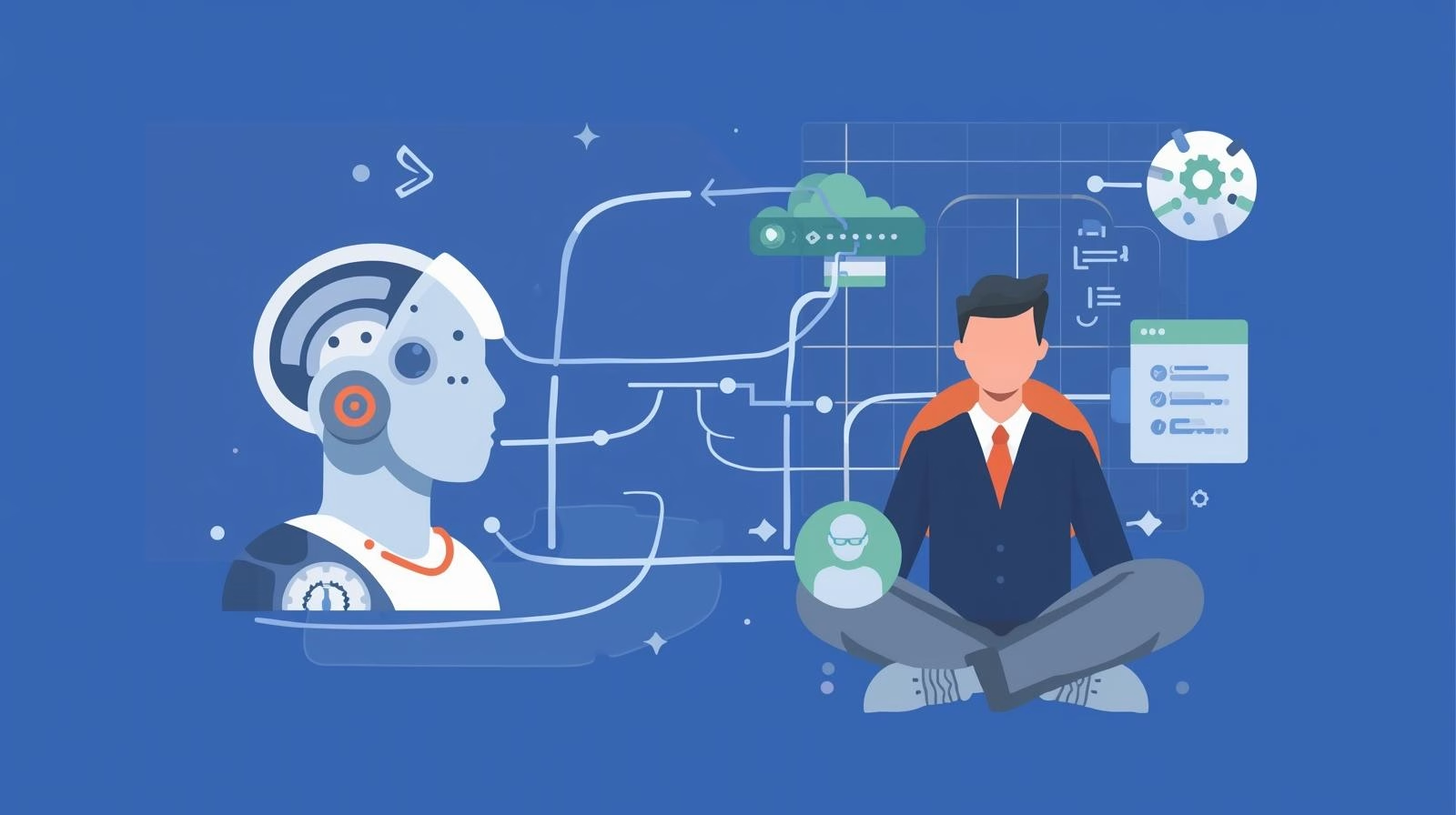
Reinforcement Learning Reinforcement learning is a subfield of machine learning in which a system learns through trial and error rather than from given examples. An agent acts within an environment, receives a reward for good decisions and a penalty for bad ones, and gradually adjusts its behaviour to maximise the total reward.
The three basic building blocks are the agent that acts, the environment in which it moves, and the reward that serves as feedback. Unlike supervised learning, there is no fixed list of correct answers from which the model learns. Instead, the agent tries out actions, observes the consequence, and learns over many repetitions which strategy yields the most reward in the long term. It is precisely this trial-and-error logic that fundamentally distinguishes reinforcement learning from unsupervised learning, which merely searches for patterns in data without a reward or target specification.
Reinforcement learning is also the foundation of modern AI agents that solve multi-step tasks. For such training to work at all, a clear reward function is needed. Whether this only evaluates the final result (Outcome-based Reward Model) or checks each intermediate step individually (Process Reward Model), is a decisive factor in the quality and traceability of the trained behaviour.
Reference to SAP Business One
For everyday ERP operations, reinforcement learning is currently relevant primarily as a foundational technology rather than as a directly visible feature. AI agents that pre-check documents, suggest postings or answer queries in SAP B1 environments are frequently built on models that have been trained or refined using reinforcement learning methods. For the user, this remains in the background. Only the result is visible: an assistant that responds more reliably to multi-step requests.
SAP B1 10.0 FP2608: Service Layer AI as a transactional layer
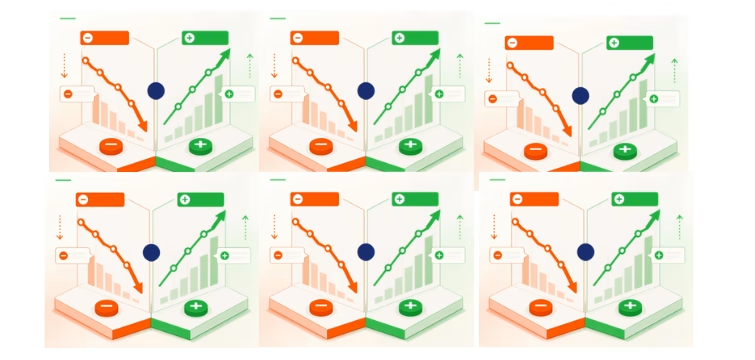
Process Reward Models: Why a correct result does not yet prove a correct method

Test-Time Compute Scaling: Why a Smaller AI Model Can End Up Winning — and What Supplier Comparison in SAP Business One Has to Do With It

RLHF and reward models: AI hype or what the approval process in SAP Business One has to do with it

AI – Answers from SAP Business One – without SQL, without IT ticket