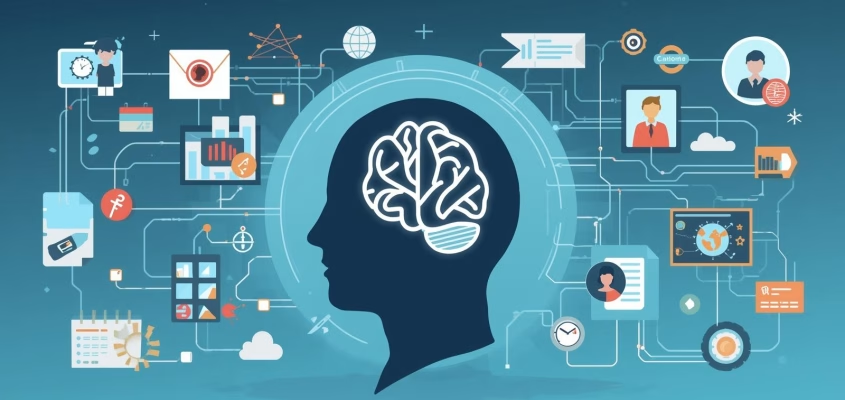
ERP systems are evolving with AI from passive data storage to learning control instruments. This change opens up new opportunities - especially for SMEs.
ERP systems were long regarded as digital archivists - stable and reliable, but backward-looking. They stored past-related data without providing any impetus for the future. With the advent of artificial intelligence (AI), this is changing fundamentally: ERP-Systems are developing into adaptive systems that provide recommendations for action and prepare decisions.
When your ERP software suddenly thinks for itself
Especially for small and medium-sized enterprises (SMEs), this creates new opportunities. According to a McKinsey study, the use of AI in an ERP context can speed up decision-making processes by up to 40 % and reduce operating costs by 20 %.
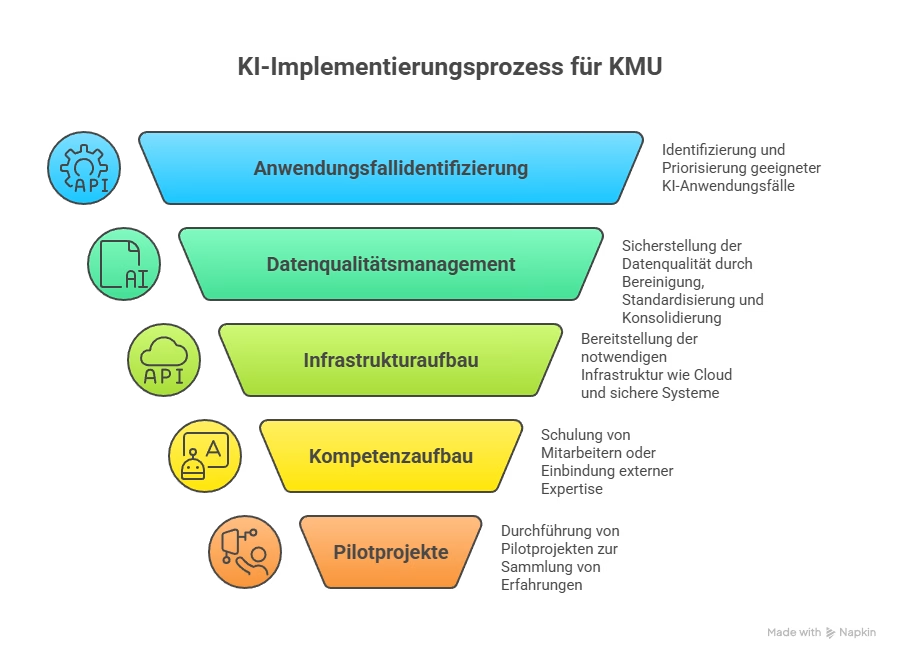
The following five insights show why the integration of AI into ERP systems is more than just a technological trend - it is a strategic turning point for SMEs.
1. from the rear-view mirror to the preview: ERP systems become forward-looking
Traditional ERP solutions deliver past-orientated metrics. AI expands this perspective: a „system of record“ becomes a „system of foresight“. Instead of just depicting actual figures, algorithms enable precise predictions - for example for:
- Sales forecasts based on historical sales data, market trends and even social media sentiment.
- Liquidity forecast, by analysing outstanding receivables, payment terms and seasonal fluctuations.
- Predictive maintenance, which utilises sensor data for early maintenance planning.
The effect: companies act earlier, faster and in a more targeted manner - with a direct impact on stability and competitiveness.
2 AI is not a privilege for large companies
The idea that AI can only be realised with data scientists, special solutions and high budgets is outdated. Modern cloud ERP systems offer Integrated AI functions, which can be used without additional programming.
They also enable Low-code and no-code platforms such as Power Automate or Make for easy integration of AI workflows - via drag & drop, without in-depth technical knowledge.
This democratisation has one clear consequence: it is not IT resources that determine success, but the willingness to innovate processes.
3. data quality is the bottleneck of every AI initiative
„Garbage in, garbage out“ applies in particular to AI in the ERP context. The effectiveness of algorithms depends directly on the quality of the underlying data. Incorrect, incomplete or inconsistent data sets lead to incorrect forecasts - with potentially serious consequences for planning and control.
Studies show that poor data quality is one of the most common causes of failed ERP projects. Companies should not treat data maintenance as a side project, but as a strategic foundation.
4 The hidden costs: AI is not a pure licence model
The introduction of AI functionalities involves more than just one-off licence fees. If you only look at the surface of the costs, you run the risk of Total Cost of Ownership (TCO) should be underestimated. In particular, the following must be taken into account:
- API and usage fees for cloud-based AI services
- Maintenance costs for models and workflows
- Expenses for data management and data protection
- Training and change efforts in the company
Scaling can become an unexpected cost driver, especially as utilisation volumes increase.
5 More than automation: AI strengthens resilience and sustainability
AI is often equated with increased efficiency. However, the strategic added value lies in the Strengthening entrepreneurial resilience and sustainable transformation. Two central potentials:
- Early crisis detection through automated risk analyses (e.g. supply bottlenecks, price fluctuations, geopolitical events).
- Sustainability monitoring automated CO₂ balances and optimisation potential in the supply chain.
AI is therefore becoming a strategic partner - not just for efficiency, but for future viability.
Conclusion: Strategic need for action for SMEs
The integration of AI into ERP systems has long been a reality. SMEs that invest now will secure sustainable benefits - in agility, decision-making quality and resilience.
However, success depends not only on the technology, but also on clear prerequisites: Clean data, realistic cost calculations and concrete application goals. If you take these points into account, you will transform your ERP system into a real co-thinker.

ERP as standard - what does that mean?
Cash flow in companies explained
Work 4.0: Faster, further, higher or deceleration?
What are the advantages of a modern ERP solution?
What distinguishes the project management from the key user?
