LLM as a Judge refers to the use of a powerful language model as an automated evaluator that assesses responses from AI systems instead of humans. The typical use is the evaluation of chat assistants for open questions.
Why a model is evaluated
Human judgment is considered the gold standard. However, it is slow and expensive. On the other hand, rule-based programs and similarity measures fail in open questions without a reference answer. A language model as a judge closes this gap. In studies, a strong model as a judge was found to agree % with human preferences by over 80%. This corresponds to the level at which humans agree among themselves.
Three forms of evaluation
In the pairwise comparison, the model determines which of the two answers is better, or it explains a tie. In the individual assessment, it assigns a score, for example on a scale of 1 to 10. In the reference-guided assessment, a sample solution is provided in the prompt, for example in math problems.
Weaknesses and countermeasures
A model as an evaluator does not judge neutrally. It often prefers the first-mentioned answer (positional bias). It prefers longer answers, even without added value (detail bias). It may also prefer its own answers. However, due to limited data volume, this effect could not be determined with certainty. Moreover, the evaluator has limited computational and logical abilities: incorrect answers in the context can lead him astray.
In contrast, several measures help. One changes the order of the answers and only explains a winner if both sequences yield the same result. Example assessments in the prompt (Few-Shot) provide the reviewer with guidance. If the reviewer solves the task first or receives a reference answer, his or her error rate for math questions drops from 70 % to 15 %. Furthermore, a custom reviewer model can be fine-tuned.
Role in AI agents
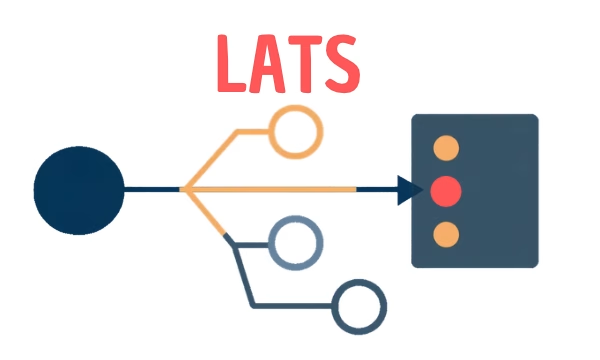
Language Agent Tree Search (LATS) uses evaluation functions that are supported by a language model. In the evaluation phase, each newly created action receives an evaluation value. This value is composed of a model assessment (LLM as a Judge) and the frequency of similar actions.
Reference to SAP Business One
If the order quantity of a customer order exceeds the available stock in SAP Business One, the availability check screens several solution options. The system does not evaluate these options and does not mark any of them as the best. The evaluation phase of LATS It would do exactly the same thing with a rating value. In SAP Business One, this rating remains with the user.
Demarcation
LLM as a Judge evaluates responses rather than generating them. Unlike similarity measures, the process does not necessarily require a reference answer. Human evaluation does not replace it as a measure: its quality is demonstrated by its consistency with human preferences.

Sprint and Swirl: How an AI agent divides work and learns from trials
LATS: Considering several paths simultaneously with AI — and the availability check in SAP B1

ReAct and RLEF: How Artificial Intelligence Learns from Real Mistakes — and What Automated Bank Reconciliation in SAP Business One Has to Do with It

SAP B1 10.0 FP2608: Service Layer AI as a transactional layer
Process Reward Models: Why a correct result does not yet prove a correct method