This series continuously examines individual basic AI terms and methods, such as the Process Reward Model. The previous episode dealt with a sobering finding: generating is cheap, verifying is the actual bottleneck. A system can generate thousands of candidate answers in a short time; the real work only begins afterwards, when the correct answer has to be found among these candidates.
Read MoreTest-Time Compute Scaling: Why a Smaller AI Model Can End Up Winning — and What Supplier Comparison in SAP Business One Has to Do With It
This is a continuation of the series on this blog that deals with Artificial Intelligence in combination with SAP Business One. It is an attempt to calmly think through and clarify fundamental AI concepts. Each episode takes a concept from current AI research and ends by asking the same question: what of this actually reaches everyday ERP operations, and what remains vocabulary that sells well? The last episode was about verification and reward models. This time it is about a simpler, but surprisingly effective idea: simply asking the same question multiple times, or test-time compute scaling.
Read MoreRLHF and reward models: The reality behind the AI hype — and what the approval process in SAP Business One has to do with it
This is the first post in a new series on this blog. It looks at the possibilities of artificial intelligence in direct interaction with SAP Business One — and not as a collection of product announcements, but as an attempt to think through fundamental AI topics calmly and thoroughly.
Read MoreAI – Answers from SAP Business One – without SQL, without IT ticket
Live webinar on 30 July 2026, 14:00–14:30 | Live demo on
Read MoreAI in ERP – but under control: What Versino AI means for SAP Business One users
AI can do a lot today – but without control, it often creates more problems than it solves. Versino AI connects AI models with your ERP and provides a cockpit alongside it, making every step visible and requiring approval. An overview for SAP Business One users.
Read MoreSAP KI Vision: The Autonomous Enterprise
Hardly a week goes by without the announcement of more intelligent language models, new co-pilots or more powerful AI agents. Nevertheless, SAP CEO Christian Klein takes a sobering view in his current blog post „The AI race is changing direction“ (June 2026): A large proportion of AI offerings provide little added value for companies in practice because they do not reflect business reality. His vision of the autonomous enterprise therefore follows a clear principle: humans set the direction, AI implements it.
Read MoreCrystal Reports on AI
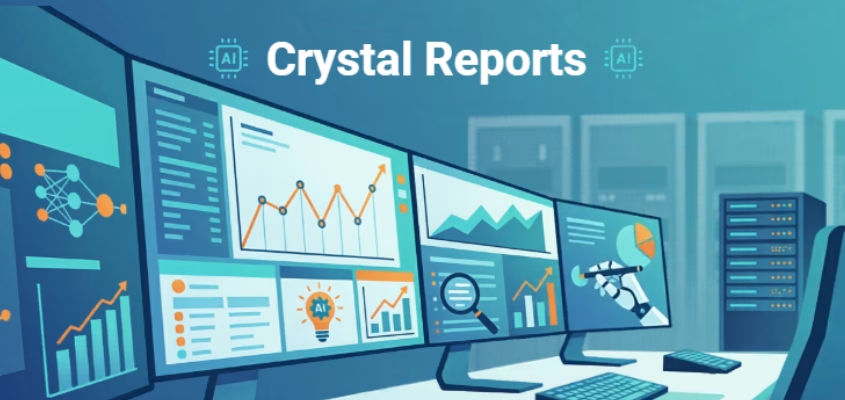
Anyone who develops their own reports in SAP Business One quickly encounters
Read MoreWhy companies are hesitant about AI in ERP
Artificial intelligence in the ERP context raises high expectations, as significant productivity gains, far-reaching automation and more informed decisions are on the horizon. Nevertheless, many companies are currently hesitant when it comes to practical implementation. This is mainly due to the fact that implementation risks, unclear potential benefits, high integration costs and cultural hurdles often act as a massive brake.
Read MorePredictive maintenance: how to turn SMEs into smart factories
In today's intelligent world, the ability to solve problems is
Read MoreRPA in the ERP environment: increasing efficiency through digital process assistants
Many ERP systems run processes on a daily basis that are necessary but do not add value. Employees spend valuable time manually entering orders, laboriously checking invoices or comparing documents. As a result, these repetitive tasks tie up resources that are more urgently needed elsewhere. This is precisely where Robotic Process Automation (RPA) comes in. Software robots take over these tasks, work around the clock and document every step seamlessly. Especially for medium-sized companies, RPA in combination with the existing ERP system opens up a concrete entry into automation without having to change the entire system.
Read More