One REST API (Representational State Transfer) is an interface style where system resources are accessed via HTTPS URLs and using the standard methods GET, POST, PATCH and DELETE read or modified. The exchange usually takes place as JSON, states are not held on the server, and each request contains all the information it needs to be processed.
Context
In the SAP Business One environment, the most important REST API is the Service Layer v2 under /b1s/v2/. It represents the business objects — items, Business Partners, Orders, Invoices, ProductionOrders — are provided as OData-v4 endpoints and responds in JSON. Typical tasks include connecting web shops, synchronisation with third-party systems, Python/Node.js microservices, and building B2B portals. From a developer's perspective, the authentication session-based via the login endpoint with set B1 SESSIONCookie; Requests are paginated to 20 records by default and must be over @odata.nextLink to be forwarded. In addition to the Service Layer, many Versino extensions such as DMS access or the Versino Financial Suite offer their own small REST endpoints for specific use cases.
Demarcation
A REST API differs from the older SOAP-Approach of the DI server with lower overhead, leaner payloads and no use of WSDL contracts. Compared to the UI API is it exclusively data and process-oriented — it does not influence the SAP interface. In the B1 context, REST does not automatically mean „Service Layer": B1if scenarios can also publish REST endpoints, and webshop connectors often offer their own REST routes above the Service Layer.
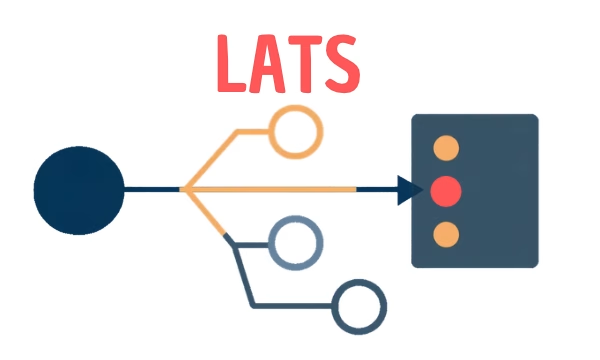
LATS: Considering several paths simultaneously with AI — and the availability check in SAP B1

ReAct and RLEF: How Artificial Intelligence Learns from Real Mistakes — and What Automated Bank Reconciliation in SAP Business One Has to Do with It

SAP B1 10.0 FP2608: Service Layer AI as a transactional layer
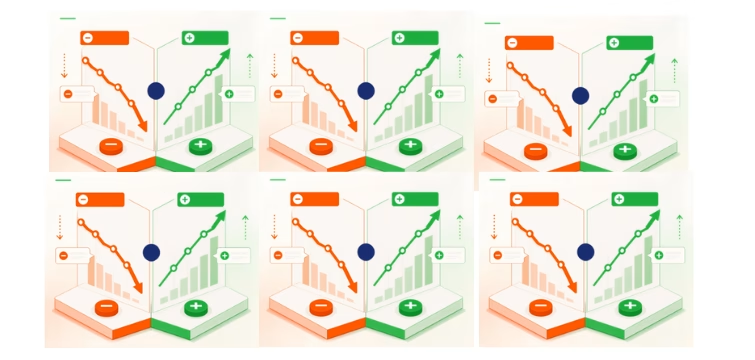
Process Reward Models: Why a correct result does not yet prove a correct method

Test-Time Compute Scaling: Why a Smaller AI Model Can End Up Winning — and What Supplier Comparison in SAP Business One Has to Do With It