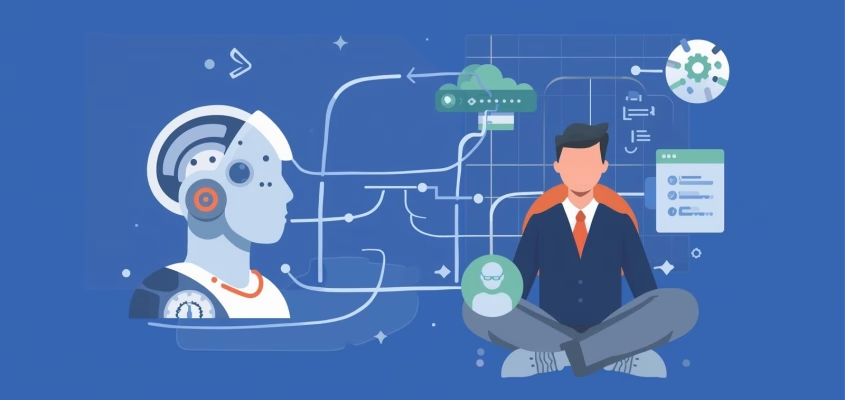
AI can do a lot today – but without control, it often creates more problems than it solves. Versino AI connects AI models with your ERP and provides a cockpit alongside it, making every step visible and requiring approval. An overview for SAP Business One users.
Read more: KI im ERP – aber unter Kontrolle: Was Versino AI für SAP-Business-One-Anwender bedeutetScarcely any topic is currently occupying the German Mittelstand as much as artificial intelligence. The tools are impressive – and yet many companies hesitate. The reason is seldom a lack of imagination, but rather a very legitimate question: What actually happens if the AI does something in my business processes that I can't oversee?
This is precisely where Versino AI The idea isn't to automate as much as possible, but to build automation in such a way that you can see, check, and stop it at any time. AI models will be connected to your business systems – and alongside them, there'll be a dashboard that maintains full control.
The real problem: not ability, but control
„AI can do a lot today – but without control, it creates more problems than it solves.“ This sentence sums up the starting situation well. An AI agent that independently sends emails, modifies datasets, or initiates payments is only an advantage as long as it remains traceable, Why he did it.
Versino AI addresses this concern with four principles.
Transparency instead of a black box
A real-time cockpit shows all active agents, their activities and their results. Every single step is logged: was was done, how long it took and was That was the result. This turns an opaque automatic process into an auditable one – important not just for the gut feeling, but also for auditing and compliance.
2. Humans make the decision at critical steps
Critical actions will not run automatically but require explicit human approval. This particularly affects:
- Changes to datasets,
- external communication and
- Financial transactions.
The AI prepares, the human authorises. For ERP users, this is the crucial difference between a „nice experiment“ and „usable in live operation“.
3. Costs remain predictable
Token consumption is tracked per agent and per task, including automatic alerts for unexpected usage. This means there are no nasty surprises at the end of the month – you can see which automation costs how much.
4. Sensitive data remains in-house
Confidential data is exclusively handled by local KI models are processed; external cloud services are only used for non-critical tasks. Where it matters, your data never leaves your network. For companies with compliance requirements, this is often the basic prerequisite.
The two building blocks: Brain and Dashboard
Versino AI consists of two components that work together.
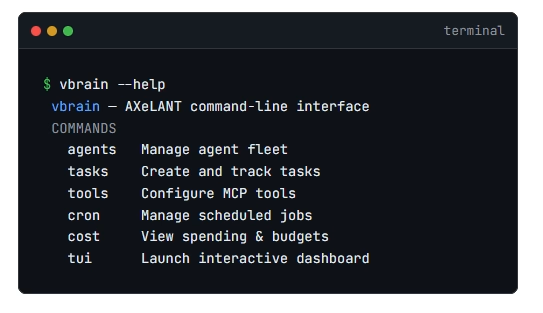
Brain version is the infrastructure layer underneath:
- Support for multiple AI providers (cloud) and local,
- secure connection to ERP APIs,
- a corporate knowledge base,
- reliable task scheduling,
- uninterrupted execution logs.
The Versino Dashboard Is the control centre above that?
- Real-time monitoring of agents and tasks,
- Approval queues for critical actions,
- a visual drag-and-drop builder for workflows,
- Notifications for Slack, Teams, and webhooks,
- Role-based access control.
What that means in everyday life – four scenarios
Task tracking. Tasks are tracked end-to-end, automatically restart on failure, and recurring jobs run reliably on schedule.
System integration. Connected tools are automatically detected and monitored – and can be tested before they go live.
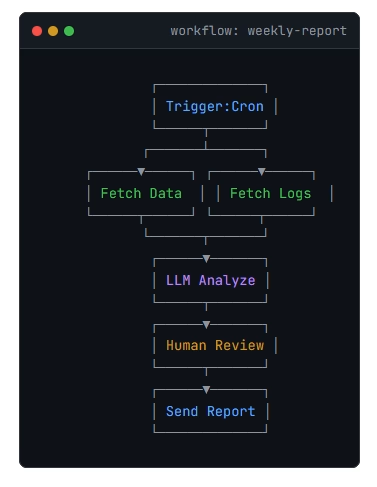
Workflow Automation. Power users build automations visually, without involving IT. For example, a weekly report that pulls in data, analyses it using AI, and sends it out after approval – all put together in just a few minutes.
Knowledge base. Uploaded documents are automatically processed as an AI knowledge source and made available to agents.
How does this fit with SAP Business One?
Connectivity is established via secure, authenticated APIs. The agents operate strictly within defined permissions and with normal validations – meaning the AI is not granted rights that a user wouldn't also have. Should something go wrong, checkpoints prevent a restart from scratch, and you will be notified immediately. Combined with the mandatory approval for critical steps, this means AI automation that integrates with existing ERP rule frameworks rather than bypassing them.
Getting started without a grand AI strategy
A common misconception: you need a company-wide AI strategy before you can get started. The opposite is the approach here – You start with a single use case. For the pricing model, there is a free basic tier; paid plans start at €199/month and scale according to the number of agents and features. Token costs are transparent, and there is no lock-in intended.
The quickest way to get concrete results is during an initial AI consultation – there, using a real-world use case from your company, we can demonstrate what can truly be automated with control. More at versino.de/ai.

AI assistant meets SAP Business One: Two paths out of the Versino AI shop

Sprint and Swirl: How an AI agent divides work and learns from trials
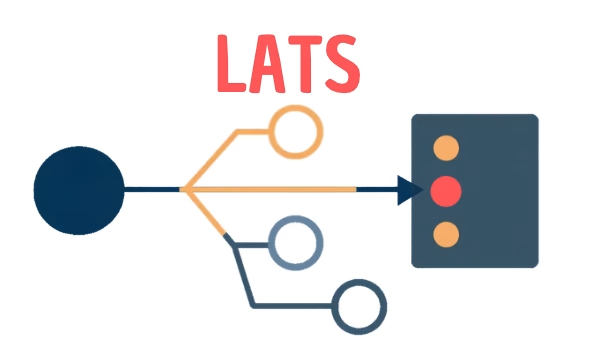
LATS: Considering several paths simultaneously with AI — and the availability check in SAP B1

ReAct and RLEF: How Artificial Intelligence Learns from Real Mistakes — and What Automated Bank Reconciliation in SAP Business One Has to Do with It

SAP B1 10.0 FP2608: Service Layer AI as a transactional layer