
On AI Agent for SAP Business One is an AI-powered assistance system based on Large Language Model technology that supports users and consultants in working with SAP B1. Unlike a classic chatbot, an AI agent can call up tools – database queries via the Service Layer, document searches in the DMS, create documents, pre-check invoices – and thus delivers not only text-based answers but also concrete actions within the system.
Context
Typical areas of application include: Knowledge Assistant — answers questions about processes, menu paths, table structures and best practices based on indexed manuals, blog articles and customer documentation; Financial Assistant — checks incoming invoices against purchase orders, suggests postings, monitors payment deadlines and due dates; Sales Assistant — answers customer enquiries with access to stock, price lists, and delivery status; Developer Assistant — generates queries, Crystal formulas and B1if-Transformations. Technically, these agents are built on Claude, GPT, or comparable models, connected via MCP servers, REST APIs, or directly via the SAP B1Service Layer.
Demarcation
An AI agent is not a replacement for a case worker – it handles recurring, rule-based tasks and provides decision templates that are reviewed and approved by humans. It is also not identical to classic OCR or robotic process automation: while RPA is rigidly scripted, an AI agent reacts to new situations with contextual flexibility and can interpret intermediate results. Important boundary conditions: data protection (no customer data to external LLMs without a processing agreement), traceability (actions must be logged and remain human-reviseable), and clear guardrail design — which actions can the agent perform, and which can it only suggest?

AI in everyday work: Here's how to find the right start

AI assistant meets SAP Business One: Two paths out of the Versino AI shop

Sprint and Swirl: How an AI agent divides work and learns from trials
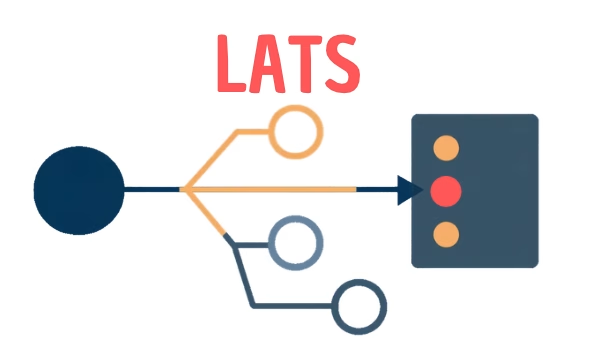
LATS: Considering several paths simultaneously with AI — and the availability check in SAP B1

ReAct and RLEF: How Artificial Intelligence Learns from Real Mistakes — and What Automated Bank Reconciliation in SAP Business One Has to Do with It