the Banff — Abbreviation for Purchase Requisition, is the document by which an employee or department formally registers a need for materials or services, before a binding order is created. It serves to structure the procurement process, obtain approvals, and include multiple suppliers in requests for quotations.
Context
Online clients via the app Create purchase order request generated. Mandatory fields are Validity date, Required date and Requestor; The requester can be an employee or a user, with their name, department, and email address being automatically populated. A purchase requisition can be sent to multiple suppliers to obtain quotes for price and delivery date—this role is typically taken on subsequently Supplier enquiries, which are copied from the BANF. Once the demand is released and a supplier is selected, the BANF becomes a an order generated; the linking plan documents the chain PR → an order → Goods Receipt → Incoming invoice. In conjunction with the approval process, requisitions (BANFs) above certain value thresholds can only be converted into a purchase order after approval by supervisors. Purchase requisitions can also be generated automatically from the MRP run if the option „Purchase Request" is selected instead of „Purchase Order".
Demarcation
The BANF (Binding Order Notification Form) is not a mandatory contract with a supplier; it's only the order that legally binds the company. It is also not identical to the supplier request , which is used specifically for price and condition inquiries to external suppliers. Compared to a conventional Booking process In a warehouse, the BANF describes an external requirement, not an internal transfer request. In smaller businesses, it is often skipped and orders are worked on directly; in larger organisations, it is the central control and release element of purchasing.

AI in everyday work: Here's how to find the right start

AI assistant meets SAP Business One: Two paths out of the Versino AI shop

Sprint and Swirl: How an AI agent divides work and learns from trials
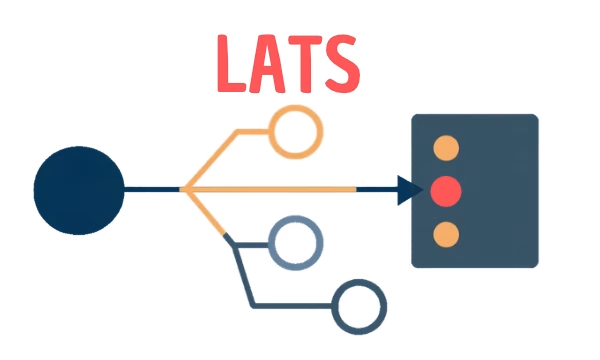
LATS: Considering several paths simultaneously with AI — and the availability check in SAP B1

ReAct and RLEF: How Artificial Intelligence Learns from Real Mistakes — and What Automated Bank Reconciliation in SAP Business One Has to Do with It