The cash book is the chronological record of all cash transactions of a company and documents every cash receipt and cash expense without gaps with date, amount and contra account. Accountingly, it reflects the movements of the cash account, which is maintained as an active asset account in current assets.
Context
In medium-sized businesses, the cash book serves as the primary record for cash transactions and provides the accounting basis for the "Cash" nominal account (e.g., SKR04 account 2820). Every cash deposit increases the cash balance and is posted as a debit, while every cash withdrawal is posted as a credit. Typical transactions include cash sales revenue, which, gross, including value added tax booked and subsequently broken down retroactively into net revenue and sales tax, cash advances from customers, and money transfers between cash and bank as a non-revenue, non-expense asset exchange (journal entry "Bank to Cash" or "Cash to Bank"). For decision-makers, the cash book thus serves simultaneously as proof of liquidity and as a basis for auditing cash processes.
Demarcation
The cash book is not identical to the cash account. The cash account is the nominal account in the financial accounting, ..., on which the balances of cash movements are kept; the petty cash book is the upstream, chronological individual record of the transactions. Similarly, the cash administration (organisational process of cash handling) must be separated from the petty cash book as a recording instrument.

AI in everyday work: Here's how to find the right start

AI assistant meets SAP Business One: Two paths out of the Versino AI shop

Sprint and Swirl: How an AI agent divides work and learns from trials
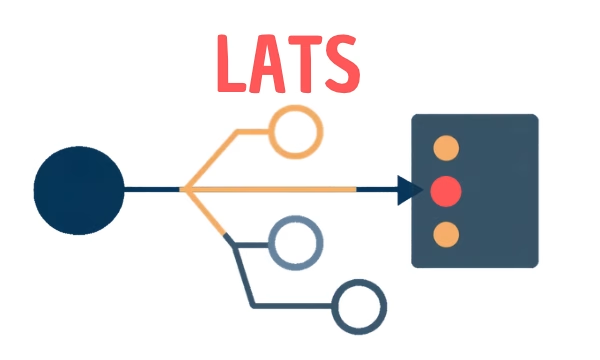
LATS: Considering several paths simultaneously with AI — and the availability check in SAP B1

ReAct and RLEF: How Artificial Intelligence Learns from Real Mistakes — and What Automated Bank Reconciliation in SAP Business One Has to Do with It