Cloudiax is a specialised cloud platform for SAP Business One, operated by Cloudiax GmbH with data centres in Germany, Austria, and Switzerland. Cloudiax provides SAP Business One installations as a hosted solution – complete with Database, Add-on infrastructure and remote access — and is aimed at medium-sized companies that do not want to operate B1 themselves.
Context
Customers book a tenant and receive a complete B1 environment on HANA or Microsoft SQL: SAP Business One client, HANA/MS SQL database, Service Layer, License Server., B1if and typical add-ons (Boyum, Coresuite, CKS.DMS, Versino Financial Suite) run centrally in the Cloudiax infrastructure. User access is primarily via the Remote Desktop Protocol client (RDP) or via web and mobile interfaces such as the SAP B1 Web Client. Maintenance — backups, feature package and patch level updates, monitoring, security patches — is handled by Cloudiax; the implementing SAP B1 partner continues to take care of specialist consulting., base data and adjustments. Many German partners explicitly bundle their offerings with Cloudiax hosting, as this lowers the entry barrier for customers without their own IT and clarifies the GDPR-relevant data locations.
Demarcation
Cloudiax is not SAP Business One Cloud in the narrower sense, nor is it identical to SAP Business One Cloud via HANA Enterprise Cloud — it is third-party hosting with its own architecture. Compared to an on-premise installation, this eliminates the effort required for hardware, operating systems, and database maintenance; however, the depth of customisation, network integration with third-party systems, and latency behaviour must be checked on a case-by-case basis. Cloudiax differs from pure infrastructure providers like Azure or AWS through its SAP B1 specialisation: operating teams are familiar with B1-specific topics such as License Server, SLD, B1 upgrade Strategy and add-on compatibility in detail.

ReAct and RLEF: How Artificial Intelligence Learns from Real Mistakes — and What Automated Bank Reconciliation in SAP Business One Has to Do with It
SAP B1 10.0 FP2608: Service Layer AI as a transactional layer
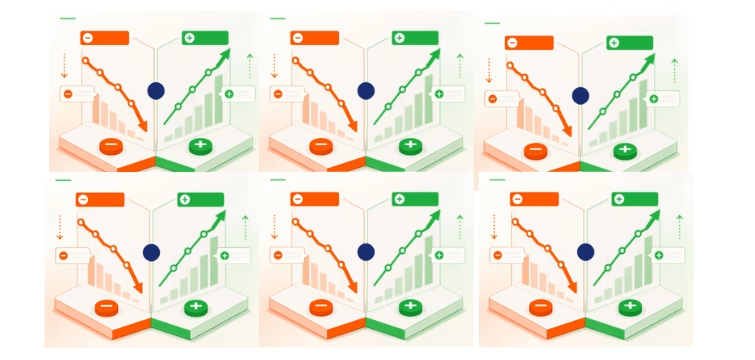
Process Reward Models: Why a correct result does not yet prove a correct method

Test-Time Compute Scaling: Why a Smaller AI Model Can End Up Winning — and What Supplier Comparison in SAP Business One Has to Do With It
RLHF and reward models: AI hype or what the approval process in SAP Business One has to do with it