On Large Language Model (LLM), in German a large language model, is an AI model that was trained using machine learning methods on extensive text data and recognizes, generates, translates, and processes natural language. The term „large“ refers to the very high number of parameters and the volume of training data.
Functionality
Language models predict, based on probabilities, which words follow an existing word sequence. A technique used for this purpose is the Transformer. It transforms words into vectors, so-called embeddings. Similarly, words receive similar vectors. Autoregressive models like GPT predict the next word or token from all previous ones.
Training
Using the example of ChatGPT, the training process takes place in two stages. First, the model learns autonomously: it predicts the next word before humans label the data. Then, people write sample texts and evaluate the responses based on their quality. Through reinforcement learning (RLHF), the system learns from these evaluations.
Deployment
LLMs create and summarize text, answer questions, and generate program code. Well-known examples are GPT-4, Gemini, Claude, and Mistral. LLMs are considered key technologies of artificial intelligence. They can be adapted for various purposes; they are also called foundation models.
Boundaries
LLMs can reproduce outdated knowledge and „hallucinate“. In contrast, RAG helps: The system retrieves external data from a knowledge base without having to retrain the model. Furthermore, the protection mechanisms of an LLM can be circumvented through „jailbreaking“. Additionally, there is a structural limitation: tasks with multiple sequential steps overload pure text generation, no matter how powerful the individual language model behind it might be.
Demarcation
Artificial intelligence is the subfield of computer science. The LLM is a key technology in this field. Generative AI primarily produces content reactively. AI agents, on the other hand, pursue goals proactively: they plan in a multi-stage manner and use external interfaces and tools. Their technical foundation is predominantly large language models. An LLM thus often forms the core of a chatbot or AI agent, but it is not the entire system.

Sprint and Swirl: How an AI agent divides work and learns from trials
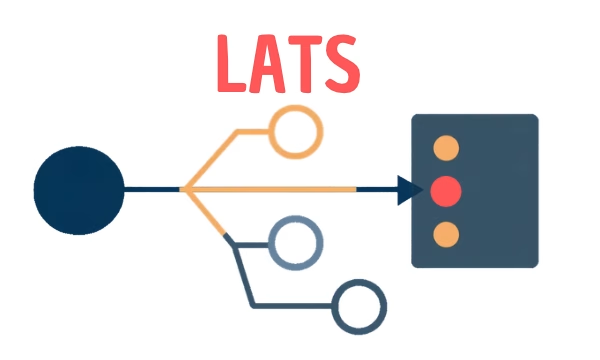
LATS: Considering several paths simultaneously with AI — and the availability check in SAP B1

ReAct and RLEF: How Artificial Intelligence Learns from Real Mistakes — and What Automated Bank Reconciliation in SAP Business One Has to Do with It
SAP B1 10.0 FP2608: Service Layer AI as a transactional layer
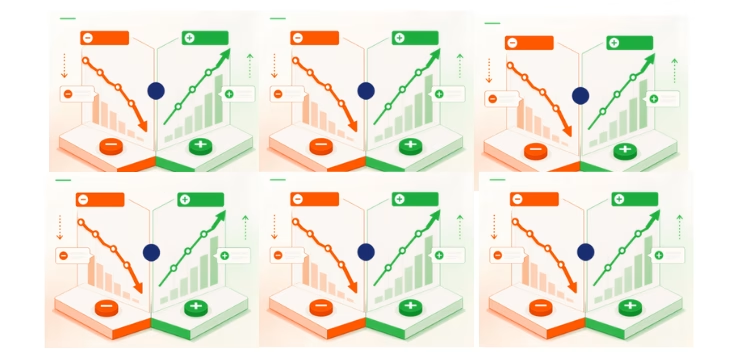
Process Reward Models: Why a correct result does not yet prove a correct method