On Chatbot is a virtual dialogue system that communicates with humans in natural language via a text input and output mask, for example via a dialog window on a website.
Classification
A chatbot is a form of bot. A bot is a computer program that performs largely repetitive tasks automatically. Alongside chatbots, there are, for example, social bots and game bots.
Deployment
Chatbots are increasingly being used in customer service. In general, they serve as a user interface. Through machine learning, chatbots can learn from input, for example to provide personalized responses.
Technical basis
Chatbots are among the applications of generative AI. Many of these applications are based on foundation models. Foundation models are characterized by the ability to be adapted to different purposes. Such an AI model can also be embedded in an architecture that integrates external tools. These tools, for example, provide real-time information or execute program code.
Demarcation
The AI agent is different from the chatbot. Generative AI systems like chatbots primarily produce content reactively. AI agents, on the other hand, act proactively: they break down tasks into steps, make decisions, execute actions, and work through external interfaces and tools. An example is booking a trip. An AI agent asks for availability, compares options, and books independently.
Social bots should also be excluded. They act as human-like actors on digital platforms.

Sprint and Swirl: How an AI agent divides work and learns from trials
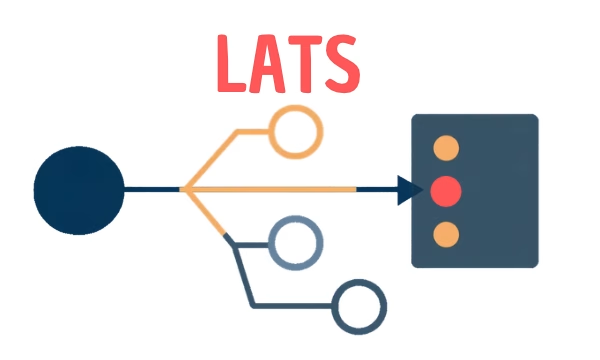
LATS: Considering several paths simultaneously with AI — and the availability check in SAP B1

ReAct and RLEF: How Artificial Intelligence Learns from Real Mistakes — and What Automated Bank Reconciliation in SAP Business One Has to Do with It
SAP B1 10.0 FP2608: Service Layer AI as a transactional layer
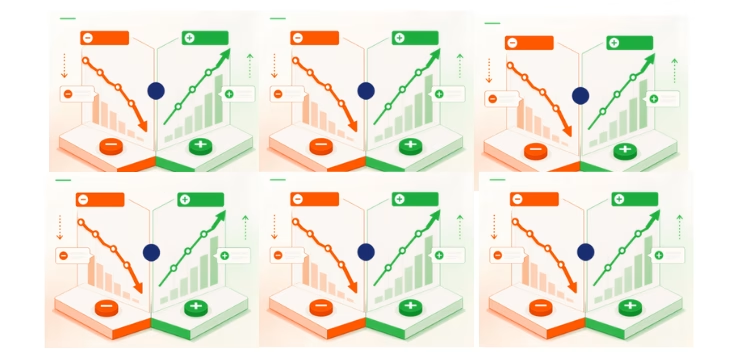
Process Reward Models: Why a correct result does not yet prove a correct method