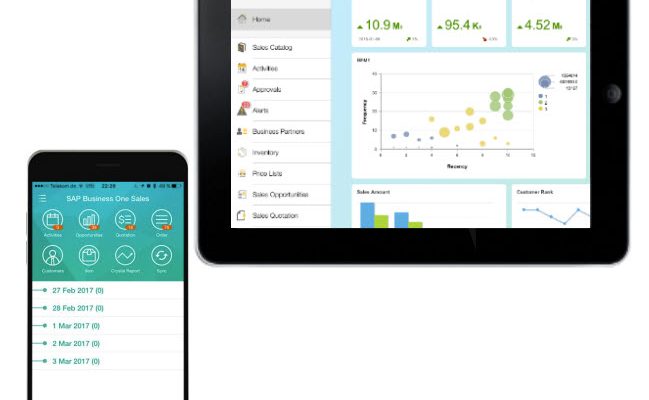
Working on the move with business software is becoming increasingly commonplace. In our everyday and working lives, the flexibility and efficiency that we gain as a result is highly valued. That is why there are always endeavours to increase mobility. Not least in the world of work. In particular, the extension of work processes to mobile devices is enjoying great growth. However, despite the frequent use of mobile devices in private life, a few things need to be considered when integrating them into working life.
1. make the mobile resources available
To integrate working with mobile devices, they must first be available. The range of smartphones, notebooks, netbooks, ultrabooks and tablets is vast. A good mix can be achieved by considering what companies expect from their „mobile“ employees. It is important to consider whether mobile devices are to be used for creating content (notebooks) or for accessing and processing it (smartphones and tablets). It is always better to introduce new devices gradually, rather than replacing old products all at once. This allows employees to become familiar with the new devices and understand the benefits of working with the new mobility.
2. determine the application types to be supported
Mobility makes little sense if it is used in the wrong places. If an employee is in frequent contact with customers, e.g. in sales, they should always be able to access the relevant information. Processing and displaying current customer data at all times is important. An end device must therefore not only be able to access this data, it must also display the information as required. It should also be possible to process and synchronise the data on the move.
3. provide network access
Without appropriate network access, true mobility is not possible, even with the best mobile devices. As mentioned in point 2, data often needs to be accessed when working remotely. This requires constant synchronisation of captured and potentially changed data. This, in turn, only works via a network. It is important that any access is structured and follows rules. With suitable management of mobile devices – such as applications personalised for specific work processes – each employee can also use „their“ device(s) privately. This creates the greatest possible mobility for employees, who have access to their work environments anytime and from anywhere.
4. update the mobile applications and products
The growth in the area of mobile applications and products is huge. This rapid progress means that everything has to be constantly updated and adapted. Once you have introduced the devices and applications to your employees, this step will often be automated. Nevertheless, you should bear in mind that some employees will always adapt to the latest applications and products, while others will always be somewhat sceptical about the new. It is your job to create a healthy balance.
5. promote innovative use
As mobile applications and products have already taken on a permanent role in our everyday lives, there will be many users who also want to test and introduce new things in their day-to-day work. Give these trials the space they need. The results will be useful, even if it's just to find out what doesn't work for you.

Mobile warehouse 2025 with Versino Warehouse Pro
COBI.wms mobile warehouse software / update
Mobile warehouse management - better storage via app
Field Service - More than just field service and maintenance
Why time tracking should be popular again
Mobile ERP software - faster and closer to the data

© 2014 | Versino Projects GmbH