Whether Siri or Alexa - voice assistants are seen as a sign of the digital future. However, these services are more likely to be used individually. This is why chatbots are becoming an exciting alternative for companies. These can also be used via Voicebut can also be operated via text. The many integration options (Facebook, WhatsApp, Telegram, etc.) also make chatbots attractive.
In the area of customer service in particular, virtual assistants can already take over one or two tasks and thus save costs. According to a study from last year, 85 % of customer interactions will be controlled by artificial intelligence (AI) by 2020. Anyone who is not entirely comfortable with this is advised to take a closer look at the current state of the art. Because all Musk's prophecies contrary, AI becomes far less scary when you take a look behind the code. Did you know, for example, that many chatbots work with a fairly rudimentary programmed AI that only ever responds according to fixed patterns? No?

Here is a small version:
How does a chatbot work?
A chatbot is (as the name suggests) a robot for chatting. Similar to a normal employee, chatbots answer customer queries, such as questions about opening hours. Questions like these can be easily processed by current AI using pre-set parameters. In this case, the AI has less complex programming in the background than if it were already „machine learning“. These chatbots often require less precise commands and can also respond to deviations in queries. For example, if you ask: „Are you open tomorrow at 11:00 AM?“ instead of „What are your opening hours?“, you will generally get more from a „learning“ AI than an „I didn't understand your question. Please repeat the question.“ So, if you're wondering how „smart“ the chatbot you're writing with is, try phrasing your questions a little differently.
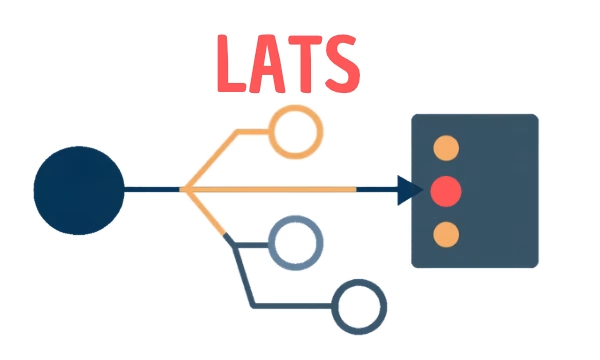
LATS: Considering several paths simultaneously with AI — and the availability check in SAP B1

ReAct and RLEF: How Artificial Intelligence Learns from Real Mistakes — and What Automated Bank Reconciliation in SAP Business One Has to Do with It

SAP B1 10.0 FP2608: Service Layer AI as a transactional layer
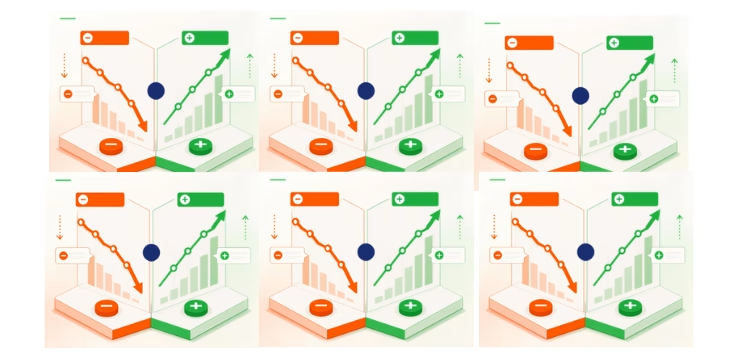
Process Reward Models: Why a correct result does not yet prove a correct method

Test-Time Compute Scaling: Why a Smaller AI Model Can End Up Winning — and What Supplier Comparison in SAP Business One Has to Do With It