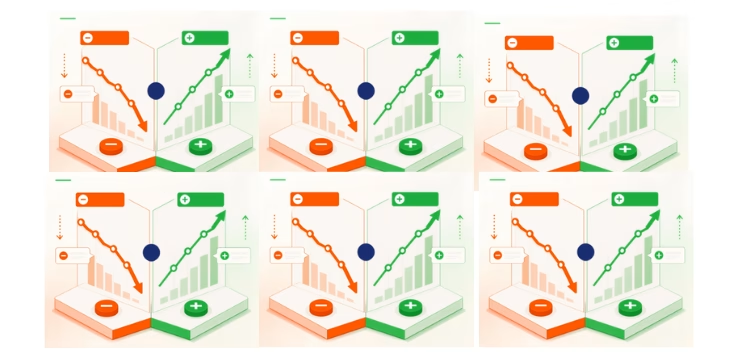
the Revenue surplus calculation (EÜR) is a type of profit determination under § 4, paragraph 3, of the German Income Tax Act. In this case, profit is considered to be the excess of operating revenues over operating expenses.
Who is allowed to use the EFR
Section 4, paragraph 3, sentence 1 of the EStG opens the EÜR to taxpayers who are not legally required to keep books and prepare regular financial statements. Furthermore, they must also voluntarily choose not to keep books and prepare financial statements. Freelancers such as doctors, lawyers, architects, engineers, authors, and artists are not required to keep books.
For commercial entrepreneurs and farmers, § 141, paragraph 1 of the AO sets the limit. They become liable to bookkeeping if they exceed one of these limits: a total turnover of more than €800,000 in the calendar year, a profit from commercial activity of more than €80,000 in the fiscal year, or a profit from agriculture of more than €80,000 in the calendar year. The obligation begins under § 141, paragraph 2 of the AO with the fiscal year following the notification to the financial authority.
Payment instead of obligation
The EFR records the accrual and depletion of funds at the time of payment. In contrast, double-entry bookkeeping records the accrual of obligations at the time of commitment, that is, the creation of a claim or obligation. The same total gain is obtained over the entire life of the business. Only the timing of the allocation differs. The EFR does not recognize provisions; they are included in the comparison of operating assets.
Special rules
The rules for low-value business assets (Section 6(2) EStG), bulk mail items (Section 6(2a) EStG) and depreciation allowances (AfA) also apply in the EÜR. For certain business assets, the acquisition or production costs are only later included in operating expenses: upon receipt of the proceeds from the sale or upon removal. This does not apply to depreciable fixed assets, shares in capital companies, securities, as well as land and buildings belonging to the current assets. The taxpayer maintains special, ongoing inventories for these business assets. Running items are excluded from the EÜR.
Recording and storage
Anyone who calculates the profit using the EÜR must also keep records and documentation in accordance with Section 147(1) of the German Tax Code. This follows from a BFH judgment of June 24, 2009. The entrepreneur records income and expenses separately according to sales tax rates. His supporting documents must be comprehensible, complete, accurate, timely, and unverifiable. It is possible to change the method of calculating the profit.
In SAP Business One
SAP Business One is designed for double-entry bookkeeping: the system works with opening, current and closing entries and generates balance sheets and GuV as financial reports.
Demarcation
The EFR is the counterpart to the operating assets comparison with double bookkeeping. The difference lies in the timing: payment in the EFR, creation of a claim or obligation in double bookkeeping. Related entries: Double bookkeeping, low-value assets, recurring items, withdrawal value.

AI assistant meets SAP Business One: Two paths out of the Versino AI shop

Sprint and Swirl: How an AI agent divides work and learns from trials

LATS: Considering several paths simultaneously with AI — and the availability check in SAP B1

ReAct and RLEF: How Artificial Intelligence Learns from Real Mistakes — and What Automated Bank Reconciliation in SAP Business One Has to Do with It
SAP B1 10.0 FP2608: Service Layer AI as a transactional layer