On Peppol Access Point English Peppol Access Point) is the technical intermediary through which companies send electronic documents — primarily E-invoices — send and receive within the Peppol network. Peppol stands for Pan-European Public Procurement Online and is today the most important cross-border e-invoicing network in Europe and growing parts of Asia.
Context
The access point uses the AS4 protocol for secure transmission and is certified according to Peppol specifications. Participants identify themselves via the Peppol Participant ID, which typically in the format 0204:Route ID (Federal) or country-specific. Three pathways are open: (1) Free service for the Federal Administration (for invoices to authorities), (2) commercial service provider (e.g. Seeburger, CGI, Ecosio, B2Brouter), (3) Operating your own access point with certified software (including some open-source products). In SAP Business One, Peppol can be used via several paths: directly via SAP Document and reporting Compliance, cloud edition with connection to the Electronic Document Service (EDS) and a suitable Peppol Exchange connector; alternatively via B1if scenarios that speak with an external provider API. Peppol is currently evolving: The PINT-Standard unites the zones of Europe and Asia, and that 5-Corner Model involves tax authorities for Continuous Transaction Controls (CTC).
Demarcation
A Peppol Access Point is not an email solution — there are at least two access points (4-corner model) between sender and receiver, which transmit documents encrypted. Nor is it a file format: Peppol transports messages in UBL or CII format — typically EN-16931-compliant e-invoices such as XInvoice or the pure XML from ZUGFeRD hybrid files. Compared to classic EDI VANs, Peppol is more cost-effective and standardised, but has less tooling for complex wholesale order/delivery note/invoice processes which EDI clearing providers often still handle better.

AI in everyday work: Here's how to find the right start

AI assistant meets SAP Business One: Two paths out of the Versino AI shop

Sprint and Swirl: How an AI agent divides work and learns from trials
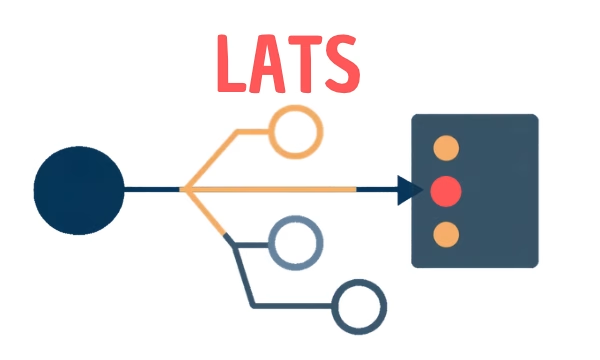
LATS: Considering several paths simultaneously with AI — and the availability check in SAP B1

ReAct and RLEF: How Artificial Intelligence Learns from Real Mistakes — and What Automated Bank Reconciliation in SAP Business One Has to Do with It