Of the BizStore persistence layer of the integration Framework for SAP Business OneB1ifIt stores all messages and their processing statuses that go through a B1if scenario: input payload, intermediate results of processing steps, output payload, error messages, retry counters, and timestamps. This makes the BizStore the basis for monitoring, error analysis, resumption, and audits of all integrations.
Context
Jede Nachricht bekommt beim Eingang eine eindeutige ID, die Sie dann verwenden können, um die Nachricht zu verfolgen. MessageID. The scenario writes the current state to the BizStore for each Processing Step – typically in a dedicated SQL/HANA database running in parallel to the Company DB. In the monitoring UI, messages can be filtered (by scenario, status, period), opened in detail, displayed with the current payload, and manually re-triggered if necessary. Errors are displayed as Failed marked and contain stack traces and the last atomic step. For revision-relevant scenarios – such as e-invoicing or supplier payments – the BizStore thus also serves as the proof of whether and when a message was sent. Retention policies determine how long messages are stored; without clean-up, the table quickly grows into the double-digit gigabyte range.
Demarcation
The BizStore is not an audit-proof document archive in the sense of GoBD – it persists integration messages, not the actual tax documents. Systems like CKS.DMS or dedicated archiving solutions are there for that. It is also not an event broker like Kafka: BizStore holds the states of a document-based messaging system, not a real-time event pipeline. It is most comparable to the Integration Message Store-Layer of classic middleware products – specialised for B1if and with a monitoring UI directly in the SLD.

AI in everyday work: Here's how to find the right start

AI assistant meets SAP Business One: Two paths out of the Versino AI shop

Sprint and Swirl: How an AI agent divides work and learns from trials
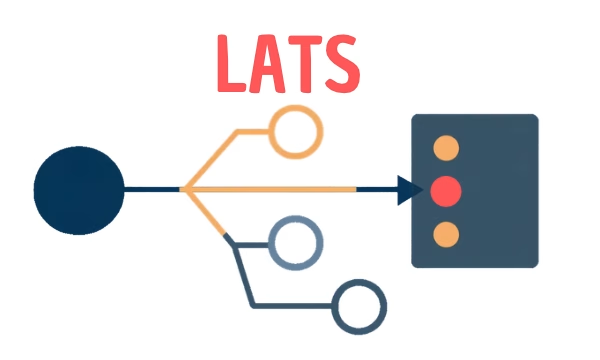
LATS: Considering several paths simultaneously with AI — and the availability check in SAP B1

ReAct and RLEF: How Artificial Intelligence Learns from Real Mistakes — and What Automated Bank Reconciliation in SAP Business One Has to Do with It