The position of each tax code determination rule within the overall hierarchy of tax determination rules.
The tax code is determined in SAP Business One according to a defined sequence in order to determine the appropriate tax code for a transaction. If there are no specific rules for determining the tax code in the document, the following priority is applied:

- Business partner master data: If a standard tax code is stored in the business partner master data, this is preferably used.
- item master dataIf the article master has a standard tax code, this is used.
- Freight definitionIf a tax code is defined for the freight, this is used.
- G/L account determinationDefined in the account determination tax code for the respective G/L account also have priority.
Adjustments and important notes
- Rule adjustmentTax code determination can be specified in SAP Business One using user-defined rules. These rules can be defined on the basis of criteria such as article groups, countries or transaction types.
- Manual customisationIf the desired tax code is not used due to the order of priority, it can be changed manually in the document.
- Master data maintenanceCorrect maintenance of the master data of business partners and articles is crucial for error-free tax code determination.
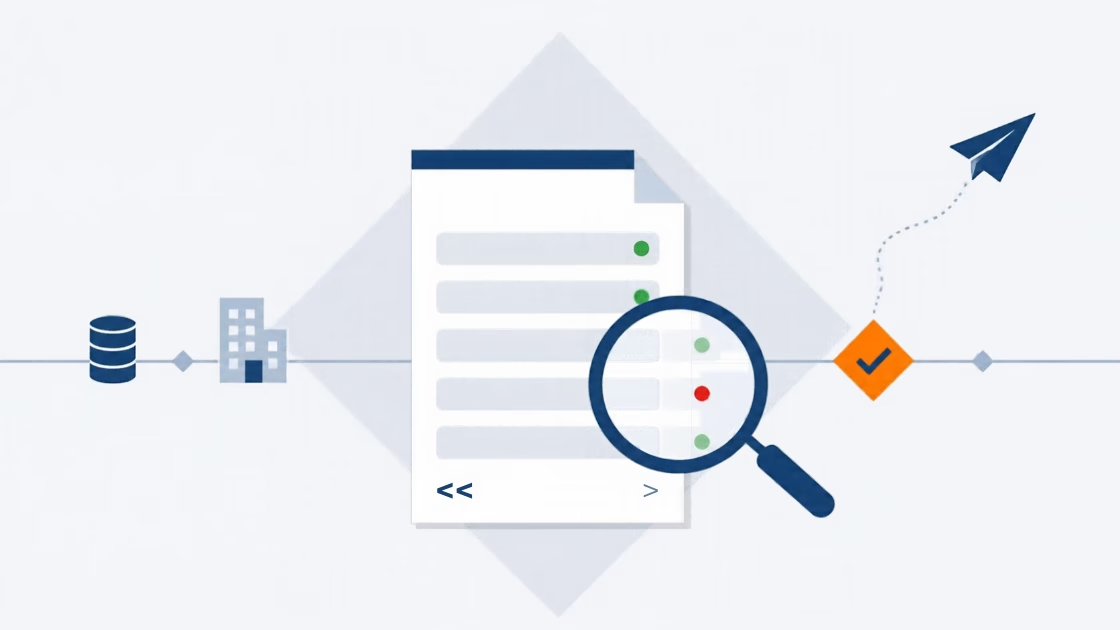
E-Invoice check by Versino Financial Suite
An e-invoice is quickly generated. SAP Business One includes the XRechnung feature as standard, and those who use cks.eINVOICE or the ...
Versino accounting service
Bookkeeping should run quietly. Vouchers come in, are posted, the VAT return goes out, and the tax advisor also gets a ...
Cash flow planning in SAP Business One: What the Versino Financial Suite does differently
Cash flow planning is considered a done deal in many medium-sized companies. After all, there are bank statements, there are open items, ...
Two free webinars in July: Experience the Versino Financial Suite live
In 90-minute sessions, we'll show you practical ways to harmonise, streamline and automate your accounting in SAP Business One….
E-Invoicing 2026: What is changing now for SMEs and SAP B1 users
The e-invoice has moved beyond the theoretical IT project phase. Since January 2025, the obligation to receive e-invoices applies to all domestic companies — ...

Netting in SAP Business One: What makes the Versino Financial Suite different
When a business partner is both a customer and a supplier, that sounds like a comfortable situation. You know each other, you trust...
