
Key Takeaways
- The post covers the application of artificial intelligence in the context of SAP Business One and fundamental AI topics.
- Thanks to AI, the hurdle between ideas and their implementation in SMEs has decreased, which makes a rethink necessary.
- Artificial intelligence can help to understand processes better and identify weaknesses before implementing solutions.
- The article explains RLHF (Reinforcement Learning from Human Feedback) and the importance of verification in AI models.
- Using the example of the ‚approval process in SAP Business One‘, it is shown how artificial intelligence can support the human review process.
This is the first post in a new series on this blog. It looks at the possibilities of artificial intelligence in direct interaction with SAP Business One. This is not intended to be a collection of product announcements. Rather, it is an attempt to think through fundamental AI topics at a leisurely pace. Reinforcement learning, reward models, verification, agents, whatever next is haunting conference presentations: each episode takes one of these terms and ends with the same question: what of it actually arrives in everyday ERP, and what remains vocabulary that sells well. We start with a term that is currently being used particularly often: RLHF.
Read more: RLHF und Reward-Modelle: KI-Hype oder was der Genehmigungsprozess in SAP Business One damit zu tun hatThe lowered hurdle — and what it changes about thinking
One might think that a new process idea in the SME sector fails primarily due to a lack of ingenuity. In reality, it usually fails much earlier, namely at the silent preliminary calculation of what the implementation would cost, even before anyone has thought the idea through to the end. Exactly this preliminary calculation is currently undergoing a shift.
The hurdle that used to stand between a process idea and its implementation has become lower thanks to artificial intelligence. What was until recently a fundamental decision involving consultancy days, functional specifications and a long lead time can now be tackled more quickly and with less effort. Some things that were recently simply out of the question because it would have been too much effort even to try them have now become feasible.
The obvious deduction would be to buy more software now. The more obvious deduction is a different one: to think differently. Anyone who no longer has to think about the hurdle of implementation first can think from the perspective of their own processes instead of from the perspective of what is supposedly feasible. The question shifts from „What can we afford to build?“ to „What would actually help us?“ and „What of that is NOT possible with artificial intelligence?“ And that is no small shift.
Artificial intelligence helps to rethink processes
The actual future model therefore lies not in the technology itself, but before it. Clarity about one's own processes, requirements and wishes is essential. Anyone who knows where the bottlenecks are in day-to-day business, which decisions are repeatedly made manually, and which information is never where it is needed has already done half the job. This applies regardless of what is ultimately implemented as a result. And this exact clarity can be achieved very well together with a Artificial intelligence think through, not just the subsequent implementation. A conversation in which one puts one's own dissatisfaction with a process into words and receives questions in return often sharpens the idea faster than any specification sheet.
What that means in concrete terms is shown later in this text using a single example from SAP Business One: a feature that has been quietly doing its job there for some time and, upon closer inspection, can be described in the exact same terms as what was just said about rethinking one's own processes. Today, it is still worth playing through such thoughts. This is true simply because the distance between idea and testing has become smaller.
One monkey, many trials, one examiner who selects
The expectation is well known: these days, an AI model simply types out the right answer, ready for publication and at the first attempt. That at least is how it sounds in a number of consultancy offers currently landing in SMEs„ inboxes with the addition of “AI-powered".
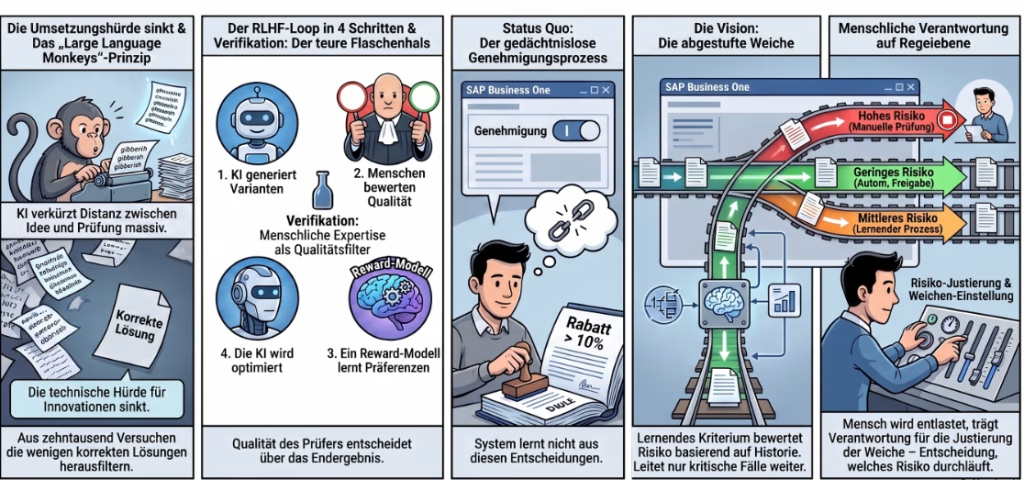
Actually, it usually works the other way around. Under the name „Large Language Monkeys Project“(all seriousness, no irony) a study has become known that proves what the infinite monkey theorem claims. Basically, it states: if you let enough monkeys bash away on a typewriter often enough, sooner or fewer a Shakespeare text will eventually emerge. Applied to a language model, this means: it is not a single perfect throw that decides the outcome, but ten thousand throws. In addition, you need someone to pick out the correct ones from these ten thousand. Smaller models like Llama 3B, 7B, or 8B still lagged behind the then-current GPT-4o with a single attempt at an answer. But when enough samples per task were generated and subsequently checked, they pulled ahead.
As an aside: Today, the same models also solve tasks that are only described in the prompt rather than being backed up with training data. This is known as „few-shot“ or „zero-shot“, and it explains why an AI system today can do more than mere text completion. Before that, however, it is worth looking at the mechanics behind the monkey theorem itself. It is about the interplay of generation and verification.
From question catalogue to examiner: how RLHF and verification interact
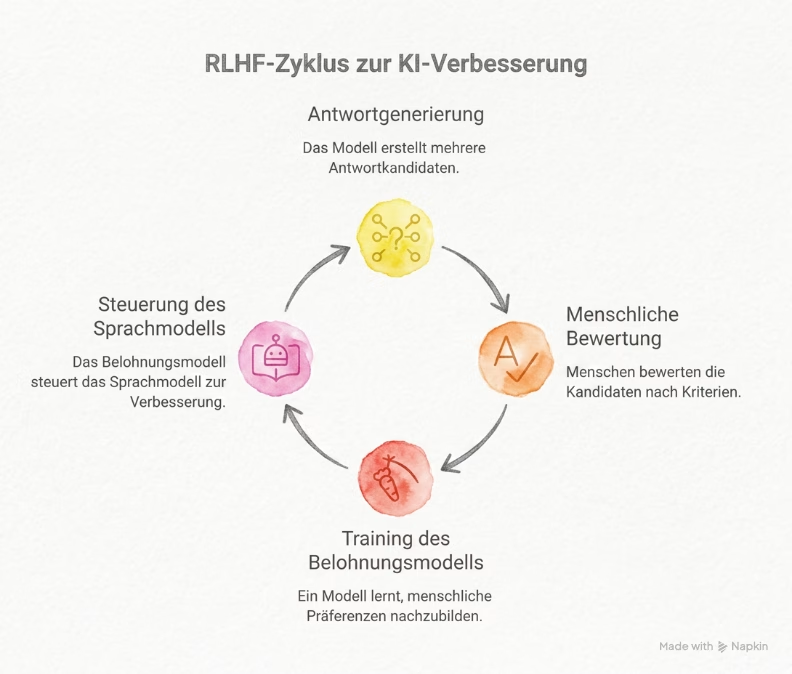
The RLHF loop in four steps
RLHF stands for „Reinforcement Learning from Human Feedback“. Together with instruction tuning, it was the crucial ingredient that turned a mere text completion tool into an interactive artificial intelligence. The process behind it is more pragmatic than the term suggests and runs in four steps.
- The model generates multiple candidate answers for one and the same question.
- People, some of whom are experts and some ordinary users, evaluate these candidates based on criteria such as correctness, usefulness and harmlessness, deciding which answer is better and which is worse.
- An own model is trained from precisely these reviews, the so-called reward model. It thereby learns to automatically replicate human preferences.
- In a further training step, this reward model then controls the parameters of the actual language model in such a way that responses which would receive a high rating are more likely to be generated in future.
The result is a model that no longer just outputs „something plausible“. It is intended to align with human values and preferences.
Verification: a second, often underestimated instance
The RLHF loop happens once, during the training of a model. To be distinguished from this is a second mechanism. This comes into play with every single request after training has long been completed: verification. Instead of outputting one response, the model generates many. A separate selection mechanism then decides which of these is actually issued.
In verifiable domains such as program code or mathematics, this selection mechanism is remarkably sober: unit tests. Each of the generated code variants runs against automated tests, and the one that passes all tests wins. In non-verifiable domains, such as running text or creative writing, there is no automated „right“ or „wrong“. Here, a second language model acting as a judge takes the place of the unit test: „LLM as a Judge“.
The generator-verifier gap
Why is all this effort of multiple generation even worth it? Because generating is cheap and checking is expensive. A model can produce thousands of plausible-sounding answers in a short space of time. Whether the answers are actually usable is another question. In the „Large Language Monkeys Project“, this had to be taken quite literally for some of the most difficult tasks: among ten thousand artificial intelligence-generated solutions for a single problem, sometimes only three or four were actually correct. However, as long as the verifier can reliably distinguish between these few correct ones and the many incorrect ones, that is enough. If the verifier is poor or simply too slow (human), the checking itself becomes the bottleneck rather than the generation.
The approval process has known the principle for ages — just without a memory
Now to the ERP system that actually concerns most readers of this blog. SAP Business One has with the Approval process a feature on board that does its job unobtrusively: if a receipt violates a stored rule (such as a discount of ten percent or more), it is not simply processed. The system holds it until a supervisor approves or rejects it.
You can read this mechanism as a very simple, human-driven verification: the system generates a candidate (the document), and an approver decides whether it passes. Structurally, this resembles the role assumed by the reward model in the RLHF loop – a human evaluates, the system reacts to this evaluation. However, the crucial difference lies precisely where it gets interesting: it follows from the described mechanics that the approval process in SAP Business One does not learn from any single sign-off. Whether the manager approves or rejects today does not make the system any wiser for the next, structurally identical request. With all due respect, it remains the patient reviewer who starts from scratch after every single case. In RLHF training, a reward model shapes an independent, reusable evaluation model from precisely such human judgements.
Rules are not yet artificial intelligence
It is not uncommon in sales conversations for precisely this difference to be glossed over or skipped: a rule-based system quickly sounds „intelligent“ in its description. However, it is fundamentally different from a system that learns from evaluations.
Anyone already there will find a second function that can be classed alongside the analysis: the alarm functions. They automatically notify you of commercial discrepancies – budget overruns, falling below minimum inventory levels, exceeded credit limits – either via predefined rules or via a self-formulated SQL-query. One can also read this as a rule-based counterpart to verification: both automatically filter out deviations from a larger pool. The difference from verification in the AI context, on the other hand, is that here there is no pool of many generated variants from which the system selects. Rather, the alarm function checks a single, already established state against a fixed rule, not multiple candidates against each other.
An additional criterion in the rulebook — and a switch that decides in graded steps
At this point, one can certainly go a step further, expressly using the subjunctive, because none of the following exists as a function, and no one is announcing here that they are going to build such a thing. The approval process in SAP Business One could not only be monitored, but also extended. This applies not through an additional level alongside the existing rules, but through extensions within the set of rules itself that currently triggers the approval. Currently, the sole deciding factor is whether a fixed threshold value is exceeded. This can be, for example, a Discount be from ten percent upwards. It is conceivable that alongside such rigid thresholds, a further criterion could be introduced, which is derived not from a fixed figure, but from the history of previous approval and rejection decisions. This criterion would not replace what triggers things today, but supplement it. It could help determine whether approval is required at all or at which level it ends up.
The difference compared to a fixed threshold lies in what a single number cannot capture. A threshold of ten per cent discount knows only that single number. It does not see whether the same customer, the same combination of position and timing, or the same sales representative was unremarkable or conspicuous in previous cases. A document with an eight per cent discount, which would remain below any fixed threshold, could still be out of the ordinary. Precisely because of the combination of characteristics that deviates from everything that previously triggered an approval. A learned criterion could recognise precisely such combinations and trigger an approval where a rigid rule would remain silent. Or conversely, it could require a higher approval level, even though no single value in itself breaches a limit.
A points instead of a switch
Until now, this criterion sounded like a two-way switch: approval required or not required. However, a finer gradation is conceivable. Instead of triggering in a binary way, the criterion could assess how high the risk of misinterpretation or a rule violation would be in the specific case, and use this assessment as a switch rather than a simple toggle. Cases with a low assessed risk would pass through without further review. Cases with a higher assessed risk would go to a human for review. And in cases where the risk is assessed as very high, the system could require an additional approval level or another reviewing person.
The benefit of such a sorting mechanism would not lie in less auditing overall, but in its distribution. Human auditing time is scarce and is currently spread evenly across all cases that exceed a fixed threshold — regardless of whether the individual case actually deserves attention or merely falls above the threshold by chance. A tiered assessment would shift this attention to where it actually makes a difference and away from where a glance would not change the decision anyway.
The one who sets the points
This changes what would just have to be said about the relationship between the criterion and human decision-making. No longer would every single piece of evidence have to pass across a human desk — that would precisely be the benefit of gradation. What would remain is a different kind of responsibility:
How the switch is set—in other words, which risk level still passes without review and which does not—would not be a decision made by the system, but rather the human domain. This responsibility would lie at the level of the rule, not at the level of the individual document. Anyone who sets the threshold for „low“ generously is thereby deciding in advance on many individual cases at once, without ever having seen a single one of them.
The catch would remain the same as with any learning system, only with an additional facet. It would not only learn from good judgements, but also from careless ones. A manager who routinely waves through discounts without a closer look due to time pressure would write this negligence into the criterion, not turn it into a virtue. A misconfigured set of points would have its own, second failure mode: it would let precisely those cases pass unnoticed for which the approval process was originally established.
Who it's worth it for
This article is aimed at managing directors and CFOs working with SAP Business One who want to understand the technology behind the AI terminology in consultant and software proposals before deciding on budgets or the level of automation. Anyone who does not use SAP Business One can usually substitute this with any other ERP system. Either way, the clarification of terms regarding RLHF and verification is worth reading regardless.
The approval process in SAP Business One is not made any smarter by any of these comparisons. But anyone who knows the difference between a fixed rule and a learning reward model also has a yardstick for deciding which of their own process ideas can now be boldly thought through to the end using artificial intelligence.

ReAct and RLEF: How Artificial Intelligence Learns from Real Mistakes — and What Automated Bank Reconciliation in SAP Business One Has to Do with It
SAP B1 10.0 FP2608: Service Layer AI as a transactional layer
Process Reward Models: Why a correct result does not yet prove a correct method

Test-Time Compute Scaling: Why a Smaller AI Model Can End Up Winning — and What Supplier Comparison in SAP Business One Has to Do With It

RLHF and reward models: AI hype or what the approval process in SAP Business One has to do with it