From 1 January 2025, a mandatory requirement for the receipt of structured electronic invoices will apply to all domestic B2B companies in Germany. No deferral, no transition period for receipt – those who are not yet ready to receive today will no longer be acting in accordance with the law. For medium-sized companies, this means that e-invoicing is not a project for tomorrow. It is already a legal obligation.
Read MoreFrance E-invoicing 2026: What companies with a French tax number need to know now
From 1 September 2026, a comprehensive e-invoicing mandate will come into force in France. All companies that are based in France or have a VAT registration there will be affected.
Read MoreWhy companies are hesitant about AI in ERP
Artificial intelligence in the ERP context raises high expectations, as significant productivity gains, far-reaching automation and more informed decisions are on the horizon. Nevertheless, many companies are currently hesitant when it comes to practical implementation. This is mainly due to the fact that implementation risks, unclear potential benefits, high integration costs and cultural hurdles often act as a massive brake.
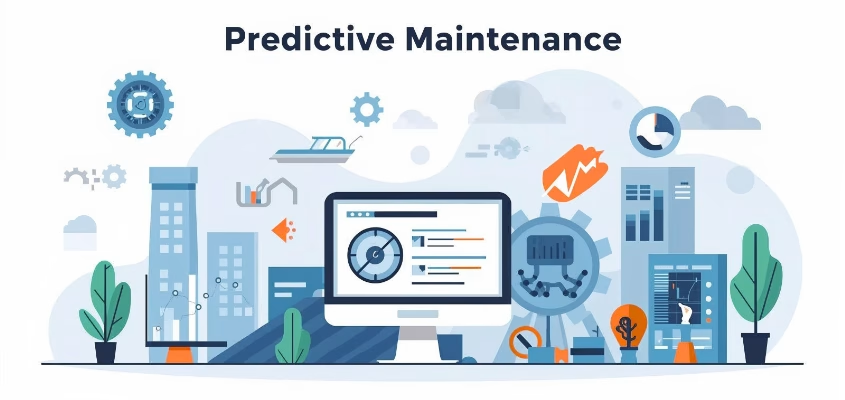
Read MorePredictive maintenance: how to turn SMEs into smart factories
In today's intelligent world, the ability to solve problems is
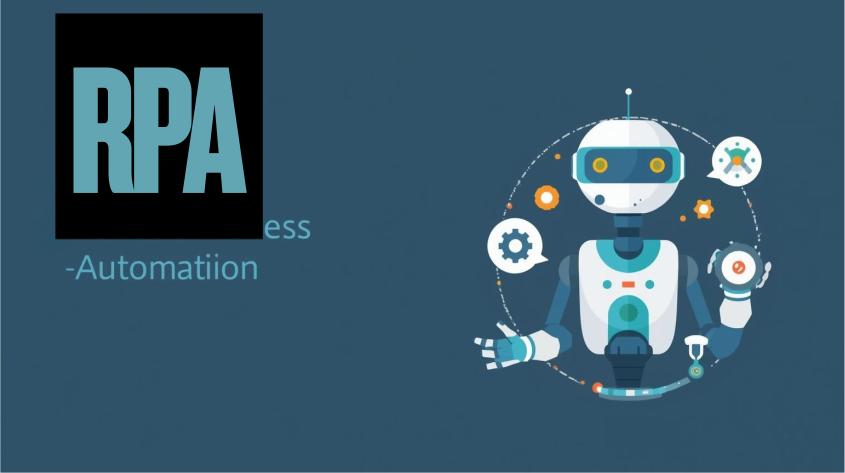
Read MoreRPA in the ERP environment: increasing efficiency through digital process assistants
Many ERP systems run processes on a daily basis that are necessary but do not add value. Employees spend valuable time manually entering orders, laboriously checking invoices or comparing documents. As a result, these repetitive tasks tie up resources that are more urgently needed elsewhere. This is precisely where Robotic Process Automation (RPA) comes in. Software robots take over these tasks, work around the clock and document every step seamlessly. Especially for medium-sized companies, RPA in combination with the existing ERP system opens up a concrete entry into automation without having to change the entire system.
Read MoreMonolithic ERP systems in SMEs: challenges, solutions and risk management
Enterprise resource planning (ERP) systems form the digital backbone of medium-sized companies. Because as
Read MoreSAP Business One Roadmap: 5 surprising truths
When small and medium-sized enterprises (SMEs) think of SAP Business One, one image often comes to mind: a rock-solid, reliable ERP system that has been reliably mapping core processes from accounting to warehouse management for years. It is the reliable engine in the background, but perhaps also a system that is not necessarily associated with the buzzwords „AI“, „low-code“ or „modern cloud architecture“.
Read MoreVersino Financial Suite V09.2025 for SAP Business One
Since the introduction of the Financial Cockpit at the start of 2025, it has been clear that the strategic focus of the Versino Financial Suite is increasingly shifting towards a centralised, powerful platform for accounting and controlling in SAP Business One. The current release V09.2025 once again adds important functions that are particularly important for corporate groups, tax firms and shared service centres.
Read MoreAccounting outsourcing: Why it pays off for SMEs
Medium-sized companies are under increasing pressure to work efficiently, fulfil regulatory
Read MoreConvert SAP Business One to camt.053 now
From 1 November 2025, the widely used MT940 format for electronic account statements will no longer be supported. Companies using SAP solutions such as SAP Business One will therefore have to switch to the SEPA-based XML format camt.053. This changeover is not only technically necessary, but also offers the opportunity to organise existing financial processes more efficiently.
Read More