An accountant is responsible for correctly recording, checking and analysing all of a company's financial transactions. He ensures orderly Accountingprepares financial statements and supports strategic decisions by analysing figures.

Detailed explanation/description:
Accountants take on central tasks in finance and accounting. Their field of activity ranges from processing receipts and invoices to reconciling accounts and preparing monthly, quarterly and annual financial statements. They usually work on the basis of generally accepted accounting principles (GoB) as well as commercial and tax regulations.
Accounting is typically divided into the following areas:
- Balance sheet and financial accounting: Responsible for P&L, balance sheets, payment transactions and provisions.
- Accounts receivable and accounts payable: Responsible for customer and supplier accounts, invoices, dunning.
- Payroll accounting: Preparation of payroll accounting, maintenance of personnel master data, notifications to authorities.
- Asset accounting: Management and evaluation of Fixed assetsdepreciation, amortisation, useful life.
Accountant in SAP Business One - Tasks and functions
In SAP Business One, accountants work with a comprehensive set of functions and authorisations to map financial processes in a legally compliant, efficient and integrated manner:
- Accounting processes: Recording business transactions, managing the chart of accounts, creating journal entries and financial reports
- Automation: Tax calculation, currency conversion, automated journal entries
- Booking periods: Management and closure of periods to comply with legal requirements
- Integration: Link with accounts payable and accounts receivable, asset accounting, cost accounting and controlling
Specific user rights for accountants
- Access to the chart of accounts (creation and editing)
- Rights for journal entries (display, enter, edit)
- Access to financial reports such as P&L, balance sheet and SuSa
- Budget control and management of cost centres
- Management and closing of accounting periods
A notice: SAP Business One does not offer a predefined "Accountant" user role, but authorisations can be individually adapted and assigned on a role basis.
Integration into business processes
Accountants use SAP Business One to map all accounting processes. Various modules and reports give them a holistic view of the company's finances and support decision-making processes with well-founded analyses.
Relevant modules and functions
- Financial accounting (FIBU)
- Accounts receivable and accounts payable
- asset accounting
- Reporting and annual financial statements
- Budgeting and period management
Concrete application examples
- Accountants record supplier invoices and carry out a factual and arithmetical check.
- They reconcile the general ledger and sub-ledger and prepare the annual financial statements.
- In the dunning process, you create payment reminders and dunning letters using the dunning assistant.
Key features/important aspects
- High level of responsibility for the correctness of accounting
- Working in accordance with GoB, HGB and, if applicable, IFRS
- Wide range of applications in almost all industries
- Flexible use thanks to SAP authorisation concept
Related terms/cross-references:
Advantages/benefits (optional):
Good accountants secure liquidity, enable well-founded business decisions and protect companies from legal and tax risks.
Best practices/instructions for use (optional):
- Regular further training, e.g. in tax law and software skills
- Precise documentation and version backup of all booking data
- Prepare collaboration with tax advisors and auditors
Target group:
Finance staff, SAP users in accounting, key users, consultants, junior staff with an interest in finance
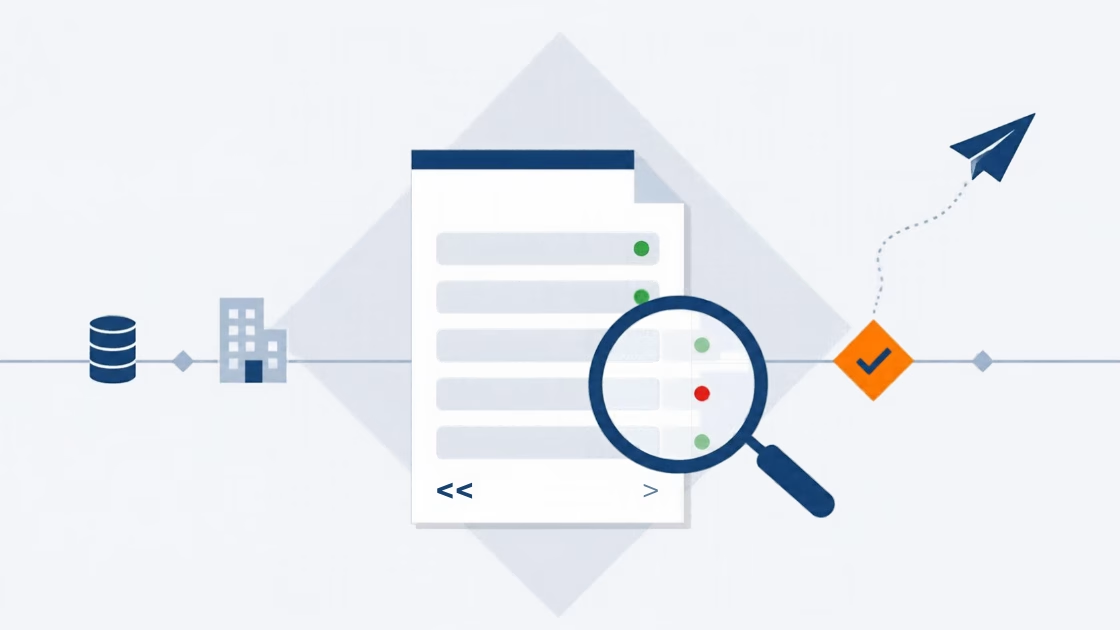
E-Rechnungs-Check der Versino Financial Suite

Versino accounting service

Cash flow planning in SAP Business One: What the Versino Financial Suite does differently

Two free webinars in July: Experience the Versino Financial Suite live
E-Invoicing 2026: What is changing now for SMEs and SAP B1 users