
Hardly a week goes by without the announcement of more intelligent language models, new co-pilots or more powerful AI agents. Nevertheless, SAP CEO Christian Klein states in his latest blog post, „The AI race is changing direction“ (June 2026) a sobering diagnosis: A large proportion of AI offerings provide little added value to businesses in practice because they do not reflect the reality of the company. His vision of the autonomous company therefore follows a clear principle: Humans set the direction, AI implements it.
Read more: SAP KI Vision: Das autonome UnternehmenWhy better AI models don't automatically deliver better results
In the discourse around artificial intelligence, it is often assumed that better models automatically lead to better business results. Klein disputes this strongly. This is because intelligent functions without operational context – that is, without the processes, data, rules, and policies that govern and protect a company – may initiate processes but hardly enable progress. In some cases, they even create additional fragmentation and new risks.
The problem is evident in practice: an AI-generated recommendation can seem convincing, yet overlook important dependencies in other parts of the system. Likewise, an AI agent can efficiently automate a workflow while simultaneously disrupting planning assumptions in another step. Klein sums it up aptly: „Businesses lack not AI output, but rather AI systems capable of understanding operational impact.“

The business context as the brain of the company
Enterprise software has been the backbone of the global economy for decades. Financial systems, supply chains, procurement networks, personnel planning, manufacturing processes, and order processing all run on networked systems. These capture not only information but also the logic behind the processes: process knowledge, governance structures, authorisations, policies, and economic relationships that have grown over many years. According to Klein, they are the brain of every company.
This precise business context will become particularly valuable in the age of AI. Without this data, AI outputs will remain well-intentioned guesses rather than informed assessments. However, if AI is directly integrated into operational processes, it can draw logical conclusions across all areas of the company: it can identify risks earlier, coordinate responses cross-functionally, provide real-time recommendations for action, and automate routine activities within defined parameters. The key is: this happens not through isolated agents working separately, but through intelligent functions linked to the company's economic and operational structure itself.
Case study: When a supplier fails
What embedded AI distinguishes from a chatbot is illustrated by an example from manufacturing. If a supplier of a critical component fails, most modern AI systems can summarise the problem or predict the likely delay. In contrast, AI embedded in processes not only provides insights but also coordinates and initiates actions. It identifies affected production plans, analyses global inventory positions, evaluates alternative procurement options, estimates the financial impact, and highlights delivery risks for customers. Simultaneously, it suggests coordinated measures for procurement, logistics, finance, and customer operations.
The same applies to finance: to predict liquidity risks in the face of volatile markets, CFOs need a context that a simple chatbot cannot provide.
What role is left for humans?
Autonomy expressly does not mean that people are excluded from decision-making. Rather, the autonomous company reduces the fragmentation and administrative overhead that prevent organisations from working quickly, cohesively, and comprehensively. The core tasks of humans remain clearly defined:
- Prioritise People define the company's strategic objectives.
- Making decisions The final decision-making on key issues remains in human hands.
- To bear responsibility Individuals retain sole responsibility for decisions and their consequences.
In turn, the AI functions as an intelligent assistant and precise executor. It coordinates operational processes related to human decisions and directly implements corresponding actions, strictly within defined permissions and guidelines.
The real AI hurdle: Change management
So far, most companies are experimenting with AI assistants, introducing pilot projects, and automating isolated tasks. Few have actually managed to increase their productivity as a result, and even fewer have fundamentally realigned their operations. The pioneers of the next phase will therefore take a different approach: they will connect intelligent functions directly to the operational systems where decisions have real business consequences. Furthermore, they recognise that trustworthy, productive AI relies on context, data quality, process integrity, and extensive process knowledge.
Above all, these companies understand that the successful use of AI is not just a technological shift, but primarily a change management challenge. Real added value is only created when AI agents, processes and people work together hand in hand.
Balance decides
Consequently, the future belongs to companies that master the balance between human leadership and intelligent system execution: humans set priorities and bear responsibility, while intelligent systems precisely coordinate processes and carry out actions. If this collaboration is successful, administrative hurdles and fragmentation will significantly decrease – and companies will operate more resiliently, productively, and intelligently in an increasingly complex world.

AI in everyday work: Here's how to find the right start

AI assistant meets SAP Business One: Two paths out of the Versino AI shop

Sprint and Swirl: How an AI agent divides work and learns from trials
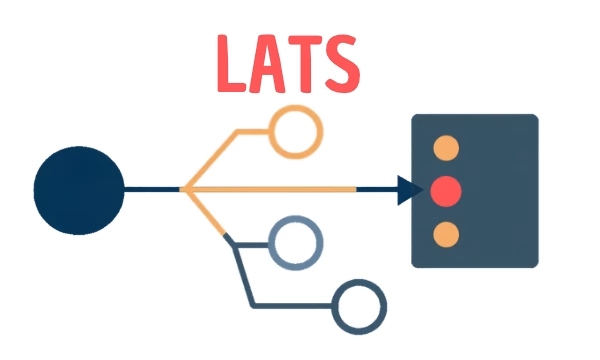
LATS: Considering several paths simultaneously with AI — and the availability check in SAP B1

ReAct and RLEF: How Artificial Intelligence Learns from Real Mistakes — and What Automated Bank Reconciliation in SAP Business One Has to Do with It