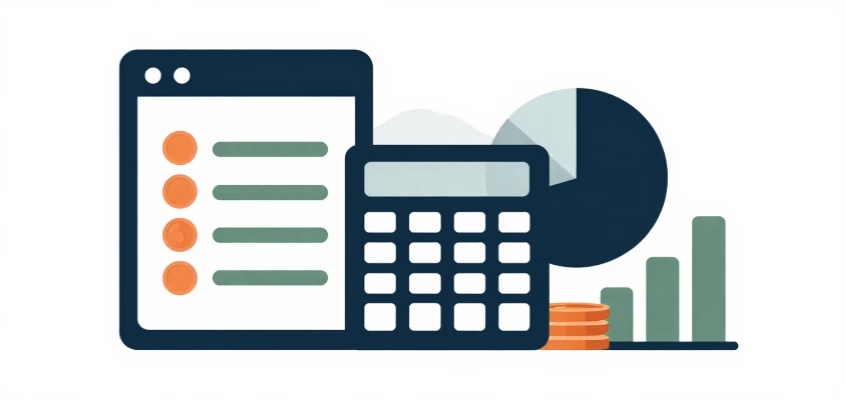
The input tax deduction allows companies entitled to deduct input tax to deduct the tax paid on incoming invoices. value added tax against its own VAT liability and reclaim it from the tax office.

Detailed explanation/description:
The input tax deduction in accordance with Section 15 UStG allows companies to treat the VAT on services received - the so-called input tax - as a transitory item. This prevents companies from bearing the VAT; it is ultimately only paid by the end consumer. The prerequisite for this is that the company is authorised to deduct input tax and has a proper invoice.
The input tax paid is recognised as part of the Advance turnover tax return deducted from the VAT received. If this results in a surplus of input tax, this amount is refunded by the tax office. Otherwise, the company must pay the difference to the tax office.
Integration into business processes
Input tax deduction affects all areas of procurement and accounting. Incoming invoices must be correctly recorded and archived so that input tax can be claimed. Input tax is typically posted as part of financial accounting via special input tax accounts in SAP Business One.
Versino Financial Suite
the Versino Financial Suite for SAP Business One supports input tax deduction by automating and simplifying the recording and posting of input tax amounts for incoming invoices. The add-on ensures that the input tax deduction is posted correctly and without errors, relieves the manual accrual process and guarantees DATEV-compliant accounting. The fast entry of incoming invoices and automated invoice accrual and deferral ensure that the VAT paid can be optimally offset against your own VAT liability so that the input tax deduction functions smoothly.
Relevant modules and functions
- financial accounting
- Purchasing
- Advance turnover tax return
Concrete application examples
- A company buys office supplies for €1,000 net plus €190 VAT. The € 190 is claimed as input tax.
- A service for € 500 net with € 95 VAT is recognised in the accounts with input tax deduction.
Key features/important aspects:
- Only applicable for companies authorised to deduct input tax
- Invoice must contain all mandatory information (e.g. VAT ID, invoice date, service description)
- Private individuals and small businesses (Section 19 UStG) are not entitled to deduct input tax
- Input tax can only be claimed for business purposes
- Partial deductibility for mixed-use goods
Deductible and non-deductible expenses:
- Not deductible: z.e.g. gifts above the exemption limit, non-business-related hospitality
- Partially deductible: Mixed-use vehicles or real estate - proportionate input tax
Invoice requirements
In order for the input tax deduction to be recognised, invoices must contain certain mandatory information:
- Full name and address of issuer and recipient
- Invoice date
- Tax number or VAT ID
- Quantity and type of goods supplied or scope of the service
- Remuneration and tax amount due thereon
Advantages/benefits (optional):
The input tax deduction relieves companies of the VAT burden and improves liquidity through refunds from the tax office.
Best practices/instructions for use (optional):
- All incoming invoices completely and correctly
- Submit advance VAT return on time
- Careful documentation for mixed-use goods
Target group:
Accountants, financial managers, company founders, SAP consultants
Versino accounting service
Cash flow planning in SAP Business One: What the Versino Financial Suite does differently
Two free webinars in July: Experience the Versino Financial Suite live
E-Invoicing 2026: What is changing now for SMEs and SAP B1 users

Netting in SAP Business One: What makes the Versino Financial Suite different