
Anyone who doesn’t book in SAP Business One on a daily basis often faces closed doors when it comes to questions regarding the financial system or has to ask for clarification in financial accounting. The AI financial chat fills this gap precisely: it provides reliable facts directly from the system to anyone who isn’t familiar with the subject. To ensure that nothing goes wrong, the chat works with read-only access and strictly adheres to the system data – without tax advice or speculation. This way, everyone can quickly get the information they need, accounting is not unnecessarily disrupted, and full control over every audit and booking is maintained at the same time.
Read more: Finanzchat für SAP Business One: Wie er Zahlenfragen beantwortet und wann er lieber nicht antwortetThe approach: keep language and numbers separate
The KI Finance Chat builds on the Versino Financial Suite and does not extend it. In addition to the suite, it does not create its own data structures.
This results in a fixed ranking: The truth comes from the suite. Where the suite has a value, that value applies. Where it has none, the standard set by SAP Business One applies. Where there is none, a rejection follows.
And then comes a division of labor. The numbers are not handled by the AI. The numbers come from the system; the AI does not compute them itself. Sums, sortings, and comparisons are performed through fixed computational paths that always work the same way.
The language is intended to serve the AI: in understanding the question and formulating the answer. That is the draft, and not every part of it is currently operational. The recognition of business partner names in everyday language is proven, for example in questions about open positions.
Two further considerations are part of the approach. The chat does not generate freely formulated database queries, but uses predefined, verified queries. And numbers should only be derived from the counterexample.
The journey from the question to the answer
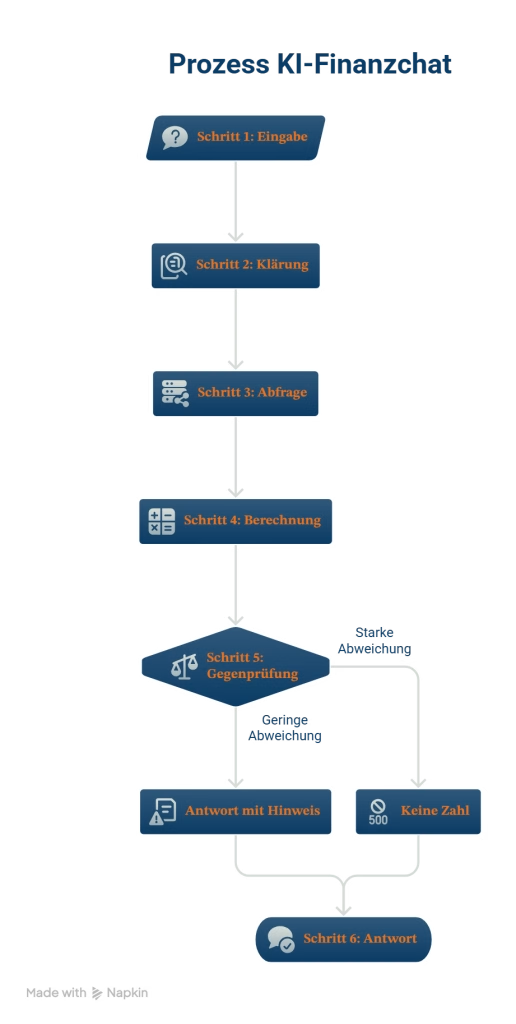
There are six steps between the question and the answer. A simple question serves as an example: How high are the open receivables owed to a specific customer?
- The question is given as a whole sentence, without any auxiliary language.
- The chat clarifies what is meant. If someone mentions an established technical term such as BWA or balance sheet list, that is clear: BWA means BWA. In open-ended formulations, the chat should assign the question to a task and, if in doubt, ask again, rather than offer a suggestion. This assignment may be wrong. Today, recognition does not yet cover every everyday formulation (as of the current state of development).
- The chat selects a predefined query from the Versino Financial Suite. In the example, it reads the customer's open invoices.
- The chat calculates. It sums up the evidence using a fixed calculation method. The AI is not involved in this process.
- The chat checks against this. The sum is then brought to the same size via a second method, for example via the customer's account balance. If the two methods differ only slightly from each other, the answer will be displayed with a hint and both values. If they differ significantly, there will be no number displayed.
- The chat replies. The number includes where it came from and how it was generated, so that the accounting department can understand it. If this cannot be verified, the answer is "no.".
If the counter-attack fails
In this approach, the cancellation is a valid result, not a mistake. That’s the most inconvenient part, and it’s intentional. A chat that always returns a number will eventually return an incorrect one.
What matters is what a counterexample is worth. It only counts if it arrives at the same size via a different calculation method. A sum that confirms itself proves nothing. Paper is patient; Excel is too. A chat shouldn’t be the way to do it.
The size of the deviation counts here. Today, this is the case for open positions: For a small deviation, there is a response with a hint of what to do and both values; for a large deviation, there is a refusal instead of an estimate. According to this approach, if the chat doesn’t know something, it will say so.
What the chat is deliberately not doing
The AI financial chat reads SAP Business One and doesn’t add anything to it. Accounting remains responsible for everything that needs to be reviewed, booked, or decided upon. The chat is supposed to take the questions off their hands, which are just a matter of checking. Questions outside of its scope, such as tax advice, are not to be answered. That’s the way it’s set up.
For whom this might be worth it
The AI Finance Chat gives management and decision-makers direct access to reliable financial figures – for quick answers on the spot, without the need to go through complex lists, reports, or spreadsheets.
Classification
Impressive would be an AI that can calculate any number itself. It would be useful to have one that allows you to see where the number comes from.

Financial chat for SAP Business One: How he answers questions about numbers and when he prefers not to answer

Versino Financial Suite Major Release: End of the SAP window cage
Account statement processing: What the Versino Financial Suite will offer in the future — a preview of accounting
E-Invoice check by Versino Financial Suite

Cash flow planning in SAP Business One: What the Versino Financial Suite does differently

Netting in SAP Business One: What makes the Versino Financial Suite different
Trial Balance in SAP Business One: What the Versino Financial Suite does differently – and why tax advisors notice

