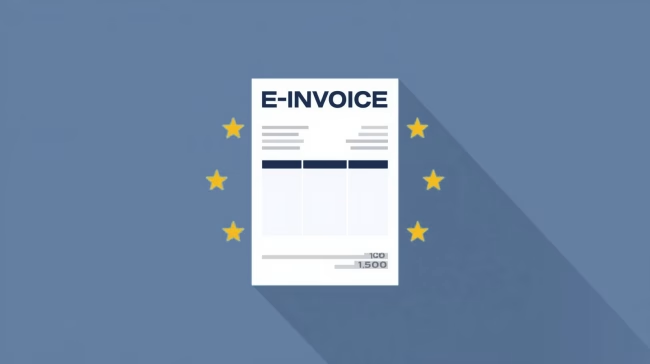
One CIUS (Core Invoice Usage Specification) is an application specification that more precisely defines the European standard EN 16931 for a specific jurisdiction or a specific network. A bill according to a CIUS remains compliant with EN 16931.
Functionality
EN 16931 establishes the common European foundation for e-invoices. The standard allows for many optional fields and leaves room for flexibility in the syntax. A CIUS deliberately restricts these options: fields that are optional in the standard become mandatory. This creates a more concise but clearer set of rules.
One example is the German XRechnung. Technically it is a CIUS and makes, among other things, the lead route ID and the order number of the public contracting authority mandatory. Whether a country uses its own CIUS is up to the country itself. Belgium, for example, does not use its own national CIUS, but the predefined format Peppol BIS Billing 3.0. Peppol BIS Billing 3.0 itself is a CIUS of the EN 16931 standard.
Significance for companies
According to the article (as of November 2025), the country-specific CIUS variants are the main cause of the technical fragmentation of the e-invoice in the EU. The article concludes from this: A single template based on EN 16931 is not sufficient. ERP systems must generate valid CIUS-compliant XML files for each target country that meet the respective national validation rules.
Demarcation
EN 16931 is the European standard with the common data model. A CIUS builds on this standard and concretizes it. The XRechnung and Peppol BIS Billing 3.0 are examples of a CIUS. UBL (Universal Business Language) and CII (Cross Industry Invoice) are, however, the two XML syntaxes that EN 16931 allows. They describe the same content in a different XML structure. See also Validation (e-invoicing).

E-Invoice check by Versino Financial Suite
Webinar E-Invoice Final Rush

E-Invoicing 2026: What is changing now for SMEs and SAP B1 users
E-Invoicing 2026: From Receipt to Mandatory Issuance — what SMEs must clarify now

E-invoicing in Europe: Harmonised standard and national fragmentation

E-invoicing in SMEs: The clock is ticking

France E-invoicing 2026: What companies with a French tax number need to know now

Service description in the e-invoice: How much detail really needs to be included?
Verifactu in Spain: the new invoicing obligation