A lot has already been written about the e-invoicing requirement. One might think that the issue is settled: the receiving obligation applies from 2025, the formats are known, SAP Business One can handle it. It could be thought that this is all settled.
It’s not. Because the crucial question remains unanswered for most companies so far: Which date actually applies to you personally? And the answer to that is emerging right now, in your ongoing figures for 2026.
Read more: Webinar E-Rechnung EndspurtTheir deadline is this year
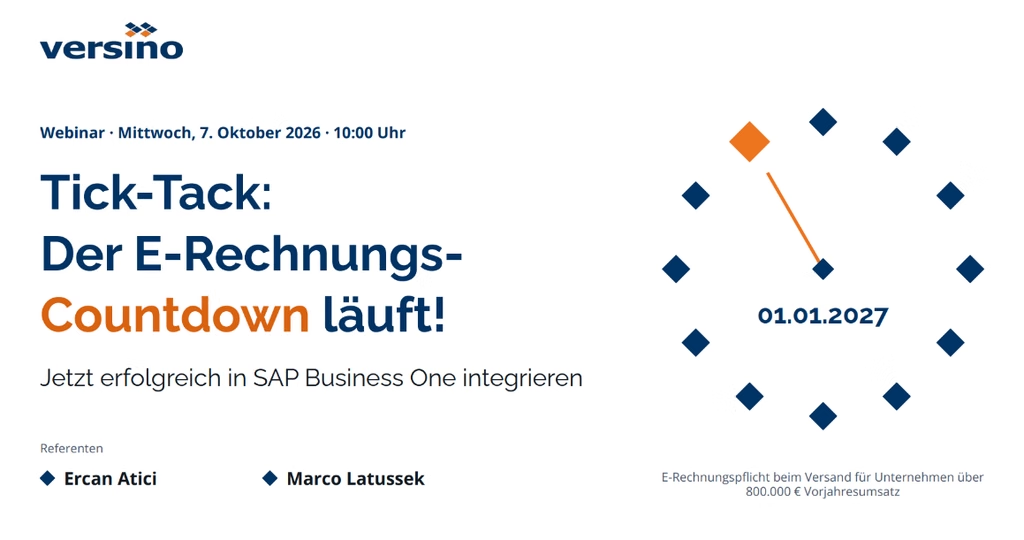
The obligation to issue e-invoices in the B2B (Business-to-Business) sector is staggered. The relevant factor is your total turnover according to § 19, paragraph 2 of the UStG (Sales Tax Act) for the year 2026, not the commercial annual turnover from the profit and loss account. If this turnover exceeds 800,000 euros, you must issue e-invoices from January 1, 2027. If it is below this, you have until January 1, 2028 to do so.
The approval is usually overlooked
The fact that PDF invoices are currently acceptable is often misunderstood as a characteristic of the format. In reality, it is a transitional rule with a condition: the recipient must agree. In practice, this almost always happens silently, with the invoice simply being paid. That is precisely why no one notices that an exception is being used here until it is removed.
By the respective deadline, companies lose this option completely. Even the customer’s consent no longer helps: A PDF invoice simply no longer qualifies as an invoice under the law.
Some cases will remain excluded, even beyond 2028: invoices to private individuals (B2C), small-value invoices, driver's licenses, small businesses, and certain tax-exempt revenues. Anyone who issues many of these invoices ends up only converting a portion of their invoice volume. This changes the scope of the project more than one initially thinks.
The license issue does not arise
For users of SAP Business One, there is an alert here: the E-invoicing capability for XRechnung is included in the standard version. No additional product, no additional license costs. The system generates and receives XRechnung as long as the functionality meets the requirements.
That takes a lot of the horror out of the situation, but not everything. Because the actual work lies elsewhere.
Where the actual effort lies
A version update is a maintenance window: planable, manageable, and completed in a manageable time. What costs time, however, are the master data. The European standard for e-invoices (EN 16931) requires information that was never used in a traditional PDF process. As long as an invoice was printed, no one noticed the missing country of origin. As soon as it is validated, exactly the position where it is missing fails.
This applies to item master data as well as business partner data and company details. And it does not apply to the entire item list at once, but primarily to the items that are actually still being invoiced. Those who prioritize relevance often significantly reduce the scope.
Another, often overlooked point: Some pre-systems and printer solutions already generate ZUGFeRD files, but in a reduced profile without full billing information. The document looks like an e-invoice, but is not legally a one. Anyone who only notices this after their own due date has a problem with ongoing invoice output.
First measure, then plan
Before you talk about costs, a simple exercise is worth doing: create a real test invoice from your system and validate it against the standard. Any broken rule shows you exactly one missing field. The result is the most reliable indication of the quality of your master data that you can obtain without a project.
In addition, an analysis helps: How many articles were actually invoiced in the last twelve months, and for how many of them are the required details fully completed? The ratio of these two numbers determines significantly how large your project will actually be. In our whitepaper, we show which fields are specifically meant and how you can prioritize the master data work without having to tackle the entire master at once.
What to do now
Anyone who is required to ship on January 1, 2027 should plan backward from the cutoff date, not forward from today’s date. Master data work cannot be squeezed into December, let alone the same weeks when annual financial statements, inventory, and vacation time all fall together anyway.
Special cases deserve their own discussion before they become a surprise in the testing phase: several clients or companies, consolidated invoices for multiple deliveries, existing EDI procedures (Electronic Data Interchange) or invoices to public contracting authorities. Our whitepaper addresses this and also provides a self-assessment in ten questions that allows accounting and IT to get a reliable overview in one hour, plus the concrete four-phase plan up to go-live and the configuration steps in SAP Business One in detail.
Webinar E-Invoice Final Rush

E-Invoicing 2026: What is changing now for SMEs and SAP B1 users
E-Invoicing 2026: From Receipt to Mandatory Issuance — what SMEs must clarify now

E-invoicing in Europe: Harmonised standard and national fragmentation

E-invoicing in SMEs: The clock is ticking

France E-invoicing 2026: What companies with a French tax number need to know now

Service description in the e-invoice: How much detail really needs to be included?
Verifactu in Spain: the new invoicing obligation
The e-invoicing regulations in Europe
