On Profit and loss account is an accounting account in which income (revenue, proceeds) or expenses (costs, expenditure) are recognised. These accounts are used to show the economic activity of a company within a specific period. Their balances flow directly into the GIncome statement (P&L) which makes the company's success (profit or loss) visible.
Species and classification:
Profit and loss accounts can be divided into two categories:

-
Revenue accounts (revenue accounts): Recognition of revenue, e.g. from the sale of goods or services.
-
Expense accounts: Recording of expenses, e.g. purchases of goods, personnel costs, rental expenses, depreciation and amortisation.
In SAP Business One, these accounts are typically categorised in the last five account areas ("drawers") of the chart of accounts. The account type (income or expense) is defined via a drop-down menu.
Use and purpose:
Profit and loss accounts are used for this purpose:
-
the structure of income and expenses in detail,
-
enable automatic bookings (e.g. A/R Invoices to revenue accounts, purchases of goods to expense accounts),
-
to create transparency about financial developments within periods,
-
enable detailed analyses and cost controls through integration in cost accounting and budgeting.
Integration into SAP Business One:
Income statement accounts are chart of accounts and about the G/L account determination automatically addressed:
-
Automatic bookings:
Outgoing invoices → Revenue account
Purchase invoices → Expense account -
Cost accounting:
Allocation to cost centersdimensions or projects in order to carry out targeted analyses. -
Budget management:
Profit and loss accounts are marked as "budget-relevant" by default in SAP Business One and enable target/actual comparisons.
Versino Financial Suite
the Versino Financial Suite improves the handling of profit and loss accounts in SAP Business One through automation, improved control and transparent analyses. This makes accounting processes more efficient and increases data quality.
Link to the income statement:
The balances of the profit and loss accounts automatically flow into the Profit and loss account (P&L) in:
-
P&L report as a central instrument for period results.
-
Possibility of periodic (annual, quarterly, monthly) presentation.
-
Various report templates (e.g. total cost method, cost of sales method) available.
-
Colour coding of accounts (active accounts in black, titles in blue, superordinate groups in red).
-
SAP Business One calculates periodic profits automatically, but a manual journal entry for profit distribution is required at the end of the year.
Example:
A company sells products and generates revenue of EUR 50,000, recognised in a revenue account. At the same time, expenses of EUR 30,000 are incurred (cost of goods sold, rent, personnel), recognised in the corresponding expense accounts. The profit and loss account therefore shows a profit of EUR 20,000.
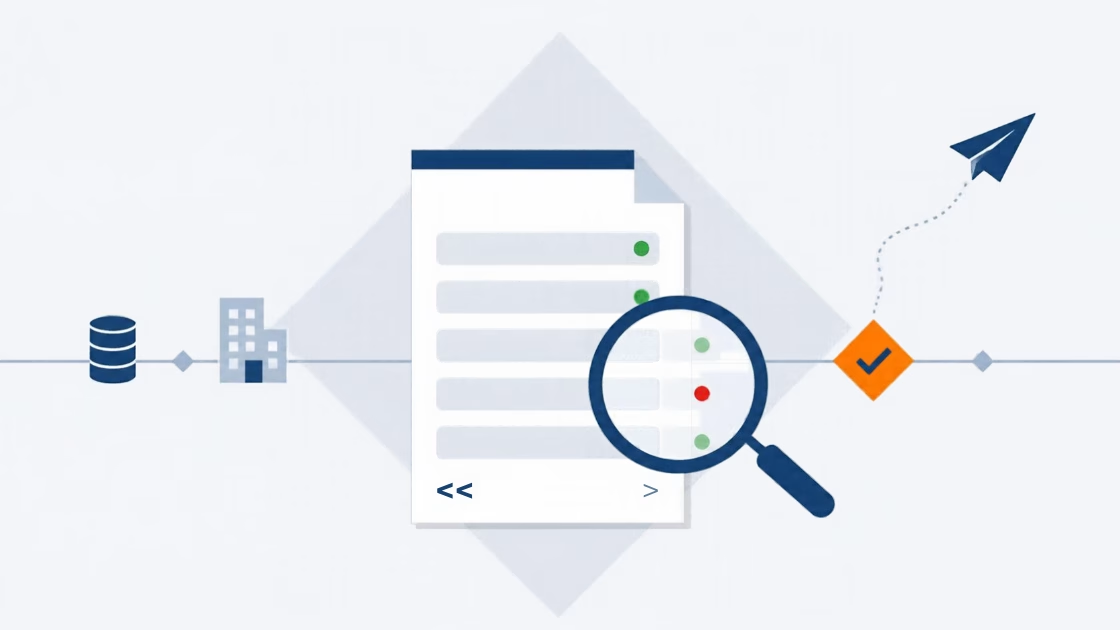
E-Invoice check by Versino Financial Suite

Versino accounting service

Cash flow planning in SAP Business One: What the Versino Financial Suite does differently

Two free webinars in July: Experience the Versino Financial Suite live
E-Invoicing 2026: What is changing now for SMEs and SAP B1 users