Every business in Germany is subject to VAT. This means that it must pay the tax levied on sales to the tax office. At the same time, a company receives a VAT refund for the amount paid on purchases (input tax). In this way, VAT becomes a transitory item. The tax office wants to be informed regularly by the companies. This is done by means of the VAT advance return.
What exactly is a VAT advance return?
In principle, the advance VAT return is a control function for taxpayers and the tax office. VAT is also an annual tax for which a VAT return must be submitted in the following year. The ELSTER system then offsets the previous sales tax payments.
If you have declared and paid all VAT (Value Added Tax) on time (i.e. quarterly or monthly), there will be no „tax liability“ on the VAT return. If too much VAT has been paid, it will also be reimbursed. The same applies, by the way, to income tax prepayments.
When do I need to register?
The small differences make all the difference: by 10 January, 10 April, 10 July or 10 October, freelancers and entrepreneurs must, in the previous year between 1,000.01 and 7,500 euros sales tax have paid their sales tax return. Is there a company above this amount, is pre-registered on the 10th of each month. lie down below value, the tax office exempts you from the Pre-registration exempt. However, the annual declaration remains.
- VAT payers have a grace period of three days. The late payment surcharge only applies from the 14th.
- After setting up a company, you must submit an advance return to the tax office for the first year and the following year.
- However, small businesses (turnover of less than 17,500 euros) do not have to submit an advance return.
Extra: Permanent extension
If 10 days is too short for you for a reliable accounting you can also apply for a one-month extension. However, if you have a monthly VAT liability, you must pay 1/11 of the previous year's tax to receive this. Settlement always takes place at the end of the year.
How to pre-register?
Submission is normally done via the ELSTER system. For this, you will need at least one certificate for your computer. This can be easily requested from the tax office – and will also be set up by them. The form then „simply“ regularly with base data and then calculate the sales tax.

Because that's not always easy, here Step by step:
Line 81: Here you enter the sales for 19% VAT (net).
Line 86: If you have to pay 7 % VAT, here are the net sales. This also applies to sales from triangular transactions.
Line 66: The input tax amounts paid are entered here. ONLY the tax amount, not the net turnover.
Here's an example:

Revenue: 1,190 euros (1,000 euros net + 19% sales tax)
Expenditure: 83.30 euros (70 euros net +19% sales tax)

Line 81:  1,000 euros (net value)

Line 66: 13.30 euros (19% sales tax value)
Line 83This will now display the VAT payable by ELSTER. Please check for plausibility and then submit it by clicking „Send tax return to tax office“ (password for certificate required).
..Important afterwards! Save the file for your own records and save it if necessary. to print out.
Now all you have to do is pay the advance VAT return and you're done.
Add-On: ELSTER for SAP Business One
The Elster add-on for electronic filing of the advance return is included as standard with SAP Business One. Continuously updated certifications ensure approval and legal certainty for companies. Even country-specific allocation rules or notifications can be taken into account and reported accordingly thanks to the flawless functioning of the installation. The VAT calculation is then automatically applied to each component of the transactions for the period. In this way, businesses can submit their monthly (or quarterly) Elster VAT return online and at the same time submit the VAT report for their own purposes.
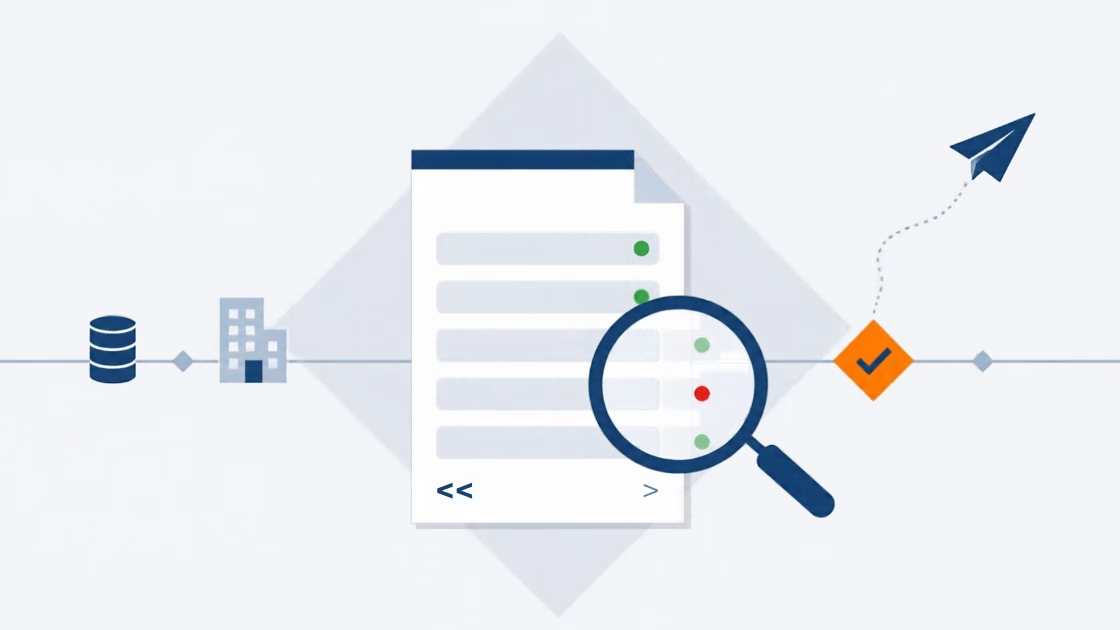
E-Rechnungs-Check der Versino Financial Suite
Versino accounting service
Cash flow planning in SAP Business One: What the Versino Financial Suite does differently
Two free webinars in July: Experience the Versino Financial Suite live
E-Invoicing 2026: What is changing now for SMEs and SAP B1 users