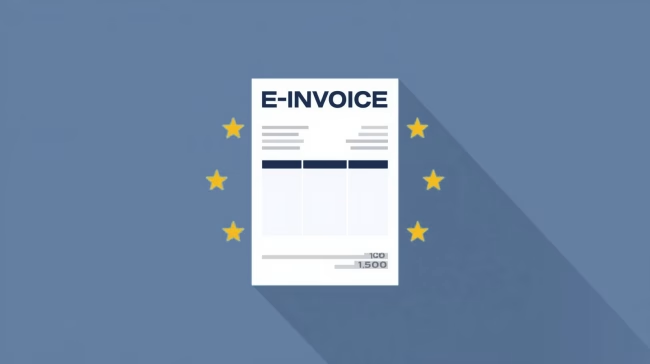
That Y model According to the article (as of November 2025), this refers to a decentralized model of ongoing transaction control (Decentralized CTC): companies exchange e-invoices via private, accredited platforms, and these platforms report the invoice data to a central government platform.
How it works, based on the example of France
France is implementing this model. The private platforms are called Partner Dematerialisation Platforms (PDP, French:Plateformes de Dématérialisation Partenaires). The French state certifies these service providers. PDPs are allowed to exchange e-invoices directly with other PDPs, without going through the public invoice portal PPF. As partners of the tax administration, PDPs additionally undertake directory management, e-reporting, and compliance audits. According to the contribution, the exchange in France is only allowed through accredited PDPs that are connected to the state platform PPF.
The French model is closely aligned with the Peppol interoperability standards. The technical challenge lies in harmonizing the XML formats UBL, CII and Factur-X. According to the contribution, Factur-X, UBL and CII are intended to be technical standards in France.
Schedule
According to the article (as of November 2025), in France, starting from September 1, 2026, a receiving obligation applies to all companies and a shipping obligation for large companies. Starting from September 1, 2027, the shipping obligation will apply to SMEs and small businesses. A specialist source (as of 2026) also lists September 2026 as the start of the mandate and a pilot phase starting in February 2026, during which companies can test their systems before launch.
Demarcation
In the clearance model (e-invoice), a central government platform checks the invoice itself. In the Y model, on the other hand, exchange and reporting take place via certified private platforms. In the four-corner model (PEPPOL), the tax authority is not involved in the transmission, as is the case in Belgium. See also Factur-X and E-Reporting (e-invoice).

E-Invoice check by Versino Financial Suite
Webinar E-Invoice Final Rush

E-Invoicing 2026: What is changing now for SMEs and SAP B1 users
E-Invoicing 2026: From Receipt to Mandatory Issuance — what SMEs must clarify now

E-invoicing in Europe: Harmonised standard and national fragmentation

E-invoicing in SMEs: The clock is ticking

France E-invoicing 2026: What companies with a French tax number need to know now

Service description in the e-invoice: How much detail really needs to be included?
Verifactu in Spain: the new invoicing obligation