What you need to look out for from 2025 The digitalisation of invoicing processes
Read More
16
october
Everything to do with SAP Business One, ERP projects and business software
What you need to look out for from 2025 The digitalisation of invoicing processes
Read More
Although the introduction of e-invoices is progressing worldwide, the legal requirements vary greatly from country to country. However, companies that operate internationally need to familiarise themselves with the specific requirements of the respective markets in order to avoid legal risks and fully exploit the benefits of digitalisation.
Read More
The GoBD includes a large number of requirements designed to ensure that bookkeeping is proper and unalterable. This applies to both the actual bookkeeping and the storage of the corresponding data. A key component is the procedural documentation, which describes in detail how the accounting processes run and how the data is managed.
Every taxable company in Germany, regardless of its size, must fulfil these requirements. This applies to both sole proprietorships and large groups such as DAX-listed companies.
Read More
HGB and IFRS pursue different objectives and approaches in accounting. While the HGB focuses on prudence, creditor protection and a close connection to tax law, IFRS emphasises shareholder value and a more optimistic, future-oriented presentation. These differences have a major influence on how companies present and value their financial results and positions. In a globalised business world, IFRS offers a more standardised and internationally comparable information basis, which is particularly advantageous for globally active companies and their investors. SAP Business One offers advanced functions to fulfil the requirements of both local HGB and IFRS and supports companies in overcoming the systematic challenges of IFRS.
Read More
Automatic journal entries in SAP Business One is one of the daily benefits that arise with every posting thanks to the integration of financial accounting into the ERP processes. This ensures that when accounting-relevant documents are created, the software automatically generates the corresponding journal entries. Accordingly, this can significantly relieve the accounting department in its daily work and frees up time for other activities.
Read More
Bank statement processing in SAP Business One enables the creation and management of incoming and outgoing payments as well as internal and external reconciliations. By automatically or manually entering bank statement details, previously unrecorded transactions such as customer payments or supplier notifications of payments made can be recorded. Bank statement processing supports various scenarios. This includes the creation, posting and internal reconciliation of incoming and outgoing payments to business partners that were made by direct debit or bank transfer and have not yet been recorded in SAP Business One.
Read More
In today's globalised business world, dealing with different
Read More From 1 January 2025, an important change for companies in the B2B sector will come into force: the mandatory introduction of e-invoicing. This step towards digital transformation not only offers more efficient processing without paperwork. Electronic invoicing also makes an important contribution to resource conservation and environmental friendliness. By using standardised formats such as XRechnung and ZUGFeRD, which comply with European standards, companies can automate and digitalise their invoicing processes.
Read More
The everyday life of a financial accountant is often characterised by searching for and comparing data. With the introduction of the new Cockpit of the Versino Financial Suite, we want to simplify precisely these daily challenges for SAP Business One users. The cockpit offers an intuitive and efficient solution for financial management by making it easier to access and analyse financial data. It remains SAP Business One, only faster, simpler and clearer!
Read More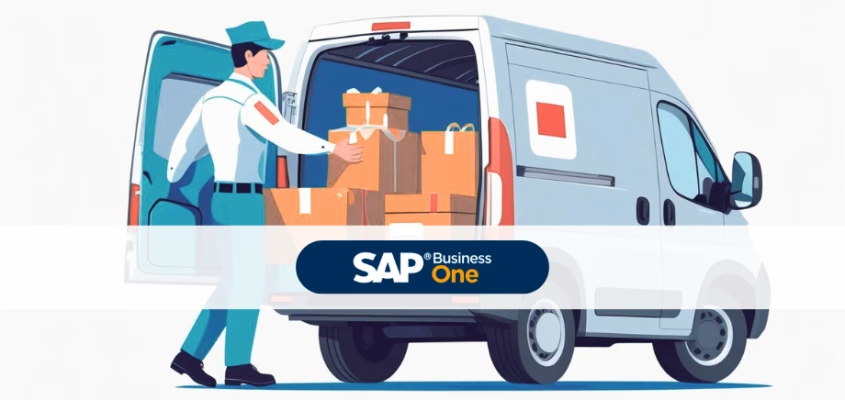
In SAP Business One, there are essentially two ways to effectively manage shipping and freight. One is to create item master data, the other is to use the specific freight definition function. Both approaches have their advantages and consequences, which should be recognised and taken into account when using them.
Read More