Outlook: The upcoming account statement processing of the Versino Financial Suite generates CAMT-053 extracts as a draft in SAP Business One.
Read More
2
Nov
Everything to do with SAP Business One, ERP projects and business software
Outlook: The upcoming account statement processing of the Versino Financial Suite generates CAMT-053 extracts as a draft in SAP Business One.
Read More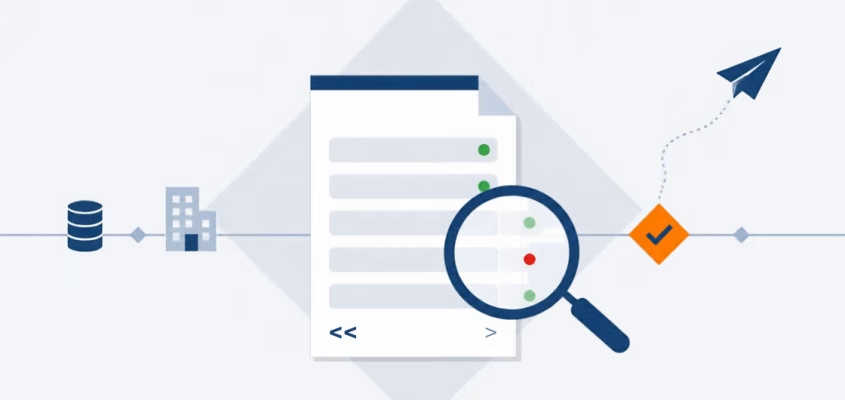
An e-invoice can be generated in no time. SAP Business One includes XRechnung as standard, and anyone working with cks.eINVOICE or the Coresuite Designer can also produce the finished file without too much hassle. One click, one document, done. That’s the ideal scenario. In practice, e-invoices rarely fail because of the generation process, but because of their content. The validation process asks for a buyer reference that has never been maintained. It asks for a contact person with a telephone number or for your own IBAN. And it usually only asks for this once the invoice is already on its way. The new e-invoice check in the Versino Financial Suite verifies the e-invoice before it leaves the company.
Read More
The e-invoicing has moved beyond the theoretical IT project phase. Since
Read More
When a business partner is both a customer and a supplier, it sounds like a comfortable situation. You know each other, you trust each other, and at the end of the month, you „simply offset“ the balances. In practice, this „simply offsetting“ is one of the most common accounting sources for uncleared balances, incorrect reconciliations, and discussions with the tax advisor.
Read More
The trial balance is one of the oldest accounting reports. Every accounting program has it, and SAP Business One naturally does too.
What one expects less: that a standard report, which at first glance does the same as its predecessor, becomes a recurring reconciliation topic with the tax advisor in practice. Versino Financial Suite has therefore developed its own version of this report — and the difference can be seen in a single column.
Read More As of 1 January 2025, every B2B company in Germany must be able to receive electronic invoices – regardless of turnover. One and a half years later, the discussion has shifted: instead of focusing on the pure legal situation, in spring 2026 the focus will be on practical application, error avoidance, and the next stage of the dispatch obligation. Companies in the SME sector that do not take action now risk an onboarding backlog with IT service providers from 2027 and, in the worst-case scenario, the loss of input tax deduction.
Read More
From 1 November 2025, the widely used MT940 format for electronic account statements will no longer be supported. Companies using SAP solutions such as SAP Business One will therefore have to switch to the SEPA-based XML format camt.053. This changeover is not only technically necessary, but also offers the opportunity to organise existing financial processes more efficiently.
Read More
There is no special module for managing loans and loan postings in SAP Business One. Nevertheless, companies, especially in the SME sector, need to record loans taken out and repaid in a clear and comprehensible manner. These processes relate to liquidity planning, reporting and tax valuation.
Read More
Credit management initially sounds like a topic that only concerns banks - until you realise as a company that overdue receivables and long payment terms can quickly become a liquidity trap. This is exactly where SAP Business One comes in: The ERP solution not only offers traditional accounting functions, but also integrated credit management with a system.
Read More
For a long time, the classic desktop client was regarded as the central control instrument for SAP Business One. But while many users still cling to the familiar interface, the web client is slowly but steadily catching up - functional, flexible and, above all, with a growing range of functions. What started out as a nice addition for mobile access is now developing into an indispensable tool for everyday work.
Read More