
The opening balance sheet forms the basis for the financial accounting and is crucial for the accuracy of the financial data. Below are some key points of the opening balance sheet in "SAP Business One":
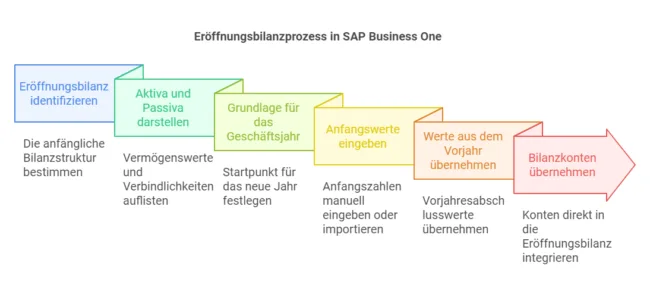
- Presentation of assets and liabilities: The opening balance sheet in "SAP Business One" lists all assets, liabilities and equity items of a company at the beginning of the financial year. It provides an overview of the company's financial situation at this point in time.
- Basis for the new financial year: The opening balance sheet serves as the starting point for all business transactions in the new financial year. Business year. All further bookings during the year are based on these initial values.
- Entering the initial values: When setting up a new company in "SAP Business One", the initial values of the various accounts must be entered manually or imported from a previous accounting system. These include cash balances, bank accounts, receivables and payables, Fixed assets and equity.
- Adoption from the previous year: For existing companies, "SAP Business One" automatically adopts the closing balance sheet from the previous year as the opening balance sheet for the new financial year.
- Balance sheet accounts and income statement accounts: While the balance sheet accounts (assets and liabilities) are transferred directly to the opening balance sheet, the income statement accounts (expenses and income) are closed via the income statement account and influence the equity in the opening balance sheet.
- Adjustments and corrections: Any corrections or adjustments required after the previous year's financial statements must be recognised in the opening balance sheet for the new year.
Creating and managing the opening balance sheet in "SAP Business One" requires care and accuracy to ensure that all financial data is correctly recorded and properly updated for the new financial year.

Payment advice in SAP Business One
In business, it is important to process payments quickly and efficiently. Payment advice notes play an important role in this. But what exactly ...
E-Invoice check by Versino Financial Suite
An e-invoice is quickly generated. SAP Business One includes the XRechnung feature as standard, and those who use cks.eINVOICE or the ...

Versino accounting service
Bookkeeping should run quietly. Vouchers come in, are posted, the VAT return goes out, and the tax advisor also gets a ...

ReAct and RLEF: How Artificial Intelligence Learns from Real Mistakes — and What Automated Bank Reconciliation in SAP Business One Has to Do with It
This is the fourth instalment in a series on this blog dealing with AI fundamentals in conjunction with SAP Business One...

Cash flow planning in SAP Business One: What the Versino Financial Suite does differently
Cash flow planning is considered a done deal in many medium-sized companies. After all, there are bank statements, there are open items, ...

SAP Business One 10.0 Feature Package 2608 / FP2608 Part 3
Feature Package 2608 (FP26608) introduces several new apps to the SAP Business One Web Client. They relate to internal ...
SAP Business One 10.0 Feature Package 2608 / New Features & Functions – Part 2
Feature Package 2608 introduces several new assistants and management apps to the SAP Business One Web Client. They concern purchase quotations, ...
SAP Business One 10.0 FP 2608 / New Features & Functions – Part 1
Function package FP 2608 enhances SAP Business One 10.0 in three areas that users will notice directly in their day-to-day operations. The Web ...

AI in ERP – but under control: What Versino AI means for SAP Business One users
AI can do a lot today – but without control, it often creates more problems than it solves. Versino AI connects AI models...
E-Invoicing 2026: What is changing now for SMEs and SAP B1 users
The e-invoice has moved beyond the theoretical IT project phase. Since January 2025, the obligation to receive e-invoices applies to all domestic companies — ...

Finance in SAP Business One
The financial system in SAP Business One contains the entries that you are legally obliged to make and enriches them with ...