One of the standard questions that a SAP Business One Consultant helps its customers to set up the Finance The first question you need to ask yourself is which chart of accounts you want to work with. In most cases, it comes down to SKR 03 and SKR 04 - the abbreviations stand for "standard chart of accounts" and thus denote the most common variants.

What gives accounting its framework

In principle, the chart of accounts a systematic list of balance sheet and income statement accounts in the accounting department. These are used to standardise financial reports and thus make them transparent and comparable. Charts of accounts differ depending on the company and its size and sector. In addition to the widely used standard charts of accounts SKR 03 and SKR 04, there is also SKR 14 for agriculture or SKR 80 for dentists, for example. All standard charts of accounts were developed by the DATEV eG but also offer possibilities for individualisation. DATEV is currently even endeavouring to reduce the number of charts of accounts that the SKR 03 and SKR 04 in order to cover the more specific requirements of some companies. However, the structure of the chart of accounts is always similar. Each chart of accounts comprises 10 account classes starting from zero. For SKR 03, for example, this would be
- Kl 0 Investment and capital accounts
- Kl 1 Financial and private accounts
- Kl 2 Accrual accounts
- Kl 3 Goods receipt and stock accounts
- Kl 4 Operating expenses
- Kl5/6 Free
- Kl 7 Inventories of products
- Kl 8 Revenue accounts
- Kl 9 Carry-forward accounts and statistical accounts
The account classes in the chart of accounts
This framework covers almost all the requirements of commercial enterprises and is also used by 60 per cent. The SKR 03 is categorised according to Processes while SKR 04, for example, is organised by P&L- and balance sheet items. Account classes zero to three are posted for the balance sheet accounts, account classes four to seven for the profit and loss accounts and account classes eight to nine for carryforward and statistical accounts. The two charts of accounts are also offered by standard accounting programmes and business software such as SAP Business One. However, once a type of chart of accounts has been selected, it can no longer be easily changed from within the system.
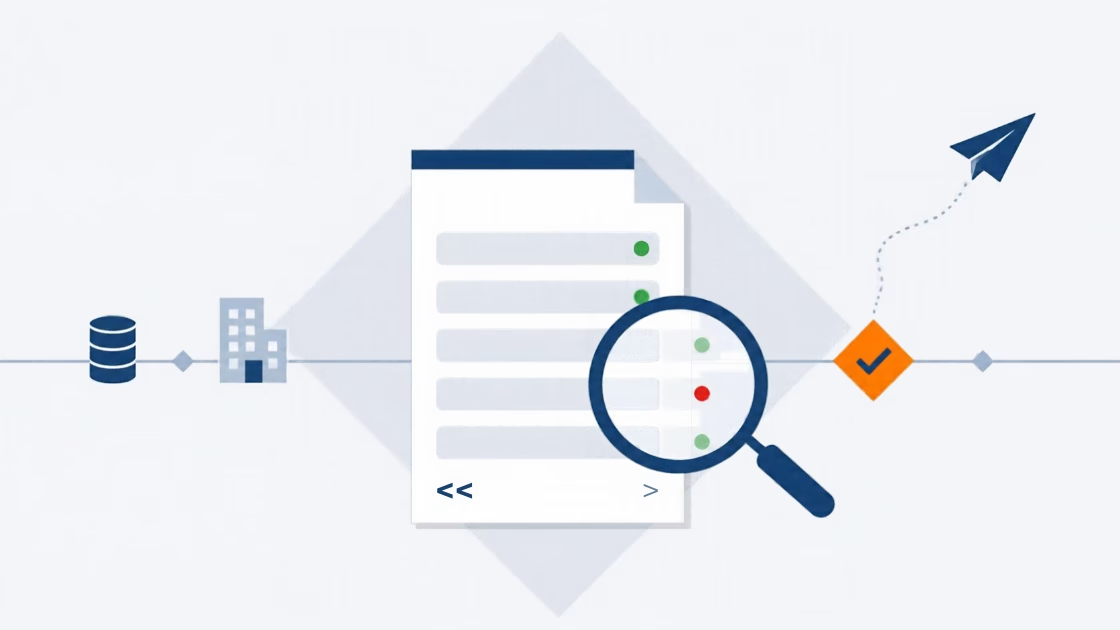
E-Rechnungs-Check der Versino Financial Suite

Versino accounting service
Cash flow planning in SAP Business One: What the Versino Financial Suite does differently

Two free webinars in July: Experience the Versino Financial Suite live
E-Invoicing 2026: What is changing now for SMEs and SAP B1 users