Another new feature in SAP Business One 9.1 is the use of perpetual inventory management. In addition to the moving average price valuation method, the standard price valuation method and the FIFO valuation method, the series/batch valuation method can now also be used.
Read MorePredictive maintenance: how to turn SMEs into smart factories

In today's intelligent world, the ability to solve problems is
Read MoreRPA in the ERP environment: increasing efficiency through digital process assistants
Many ERP systems run processes on a daily basis that are necessary but do not add value. Employees spend valuable time manually entering orders, laboriously checking invoices or comparing documents. As a result, these repetitive tasks tie up resources that are more urgently needed elsewhere. This is precisely where Robotic Process Automation (RPA) comes in. Software robots take over these tasks, work around the clock and document every step seamlessly. Especially for medium-sized companies, RPA in combination with the existing ERP system opens up a concrete entry into automation without having to change the entire system.
Read MoreGenerative AI in ERP: How LLMs are changing the role of ERP systems
With the advent of generative AI and large language models (LLMs), the role of ERP systems is changing fundamentally. Instead of just booking transactions, storing data and delivering reports, they are evolving into interactive, learning systems. As a result, they support human decisions, accelerate processes and can even replace parts of them.
Read MoreService description in the e-invoice: How much detail really needs to be included?
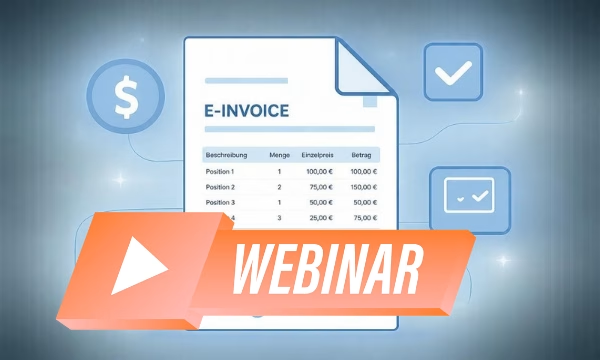
The introduction of the mandatory e-invoice shifts the focus away from the mere PDF towards structured data. This is particularly noticeable in the service description: what was previously often outsourced to attachments, service specifications or delivery notes must now at least essentially be in the data file of the e-invoice itself.
Read MorePreparing the ERP future with APIs and microservices
However, the solution approach is not to replace the monolith, but to modularise it step by step: Using an API-first strategy, external microservices, a clear three-tier architecture and hybrid integrations in cloud platforms, the ERP core is decoupled, supplemented in a targeted manner and progressively relieved - without jeopardising ongoing operations.
Read MoreE-invoicing: 7 points that entrepreneurs need to know now
The basic topic of mandatory e-invoicing has now arrived in most companies. The real uncertainty today lies elsewhere: in the details
Read MoreMARIProject 8.0.000: New design, expanded production and optimised processes
With MARIProject 8.0.000, users get a revised design with flexible Horizon themes, closer integration with the SBO Web Client
Read MoreData quality & AI : AI can only be as good as your data
Today, companies are investing massively in AI technologies, intelligent automation and modern
Read MoreAI-ERP transformation basics and AI governance
The modernisation of monolithic ERP systems through artificial intelligence (AI) does not start with algorithms, but with a clear understanding. Companies must first analyse how their existing ERP system is structured, where operational bottlenecks arise and what specific potential AI offers
Read MoreMonolithic ERP systems in SMEs: challenges, solutions and risk management
Enterprise resource planning (ERP) systems form the digital backbone of medium-sized companies. Because as
Read More