In 90-minute sessions, we'll show you practically how to harmonise, streamline and automate your accounting in SAP Business One – on 23 and 30 July 2026.
Read More
15
July
Everything to do with SAP Business One, ERP projects and business software
In 90-minute sessions, we'll show you practically how to harmonise, streamline and automate your accounting in SAP Business One – on 23 and 30 July 2026.
Read More
When a business partner is both a customer and a supplier, it sounds like a comfortable situation. You know each other, you trust each other, and at the end of the month, you „simply offset“ the balances. In practice, this „simply offsetting“ is one of the most common accounting sources for uncleared balances, incorrect reconciliations, and discussions with the tax advisor.
Read More
Version 05.2026 of the Versino Financial Suite brings two new features that directly address time wastage and system limitations that cause pain in daily work: The DATEV export now runs across multiple months in one go – what previously cost twenty to thirty minutes now takes around two minutes. And the Versino Financial Suite Dashboard is now available as a standalone application, without needing to fully start SAP Business One.
In addition to this, several positions in the reporting department and in master data have been expanded. What exactly - and where this applies in everyday life - is explained further down.
Read More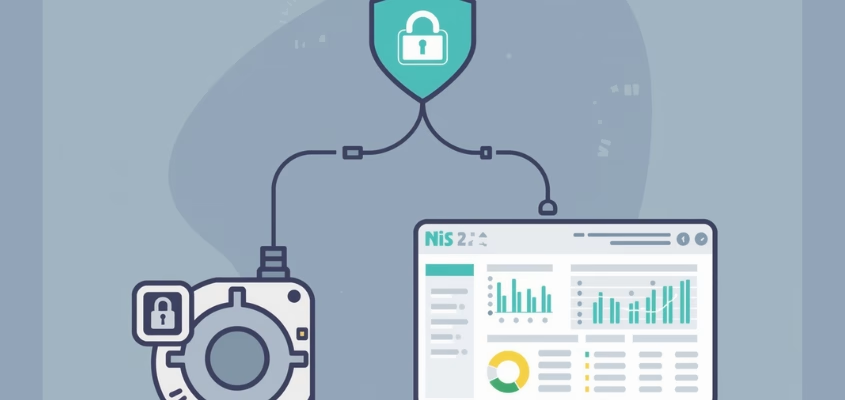
The grace period is over. Registration deadlines at the BSI expired on March 6, 2026, and the Federal Office has moved to active enforcement. For managing directors in medical technology, this means: those who have treated NIS-2 as an IT issue so far may face unexpected personal consequences.
Read More
E-invoicing is no longer a niche topic in Europe. With Directive 2014/55/EU and the technical standard EN 16931, the EU has created a common framework - but in practice, the picture is much more complex.
Read More
From 1 January 2025, a mandatory requirement for the receipt of structured electronic invoices will apply to all domestic B2B companies in Germany. No deferral, no transition period for receipt – those who are not yet ready to receive today will no longer be acting in accordance with the law. For medium-sized companies, this means that e-invoicing is not a project for tomorrow. It is already a legal obligation.
Read More
Artificial intelligence in the ERP context raises high expectations, as significant productivity gains, far-reaching automation and more informed decisions are on the horizon. Nevertheless, many companies are currently hesitant when it comes to practical implementation. This is mainly due to the fact that implementation risks, unclear potential benefits, high integration costs and cultural hurdles often act as a massive brake.
Read More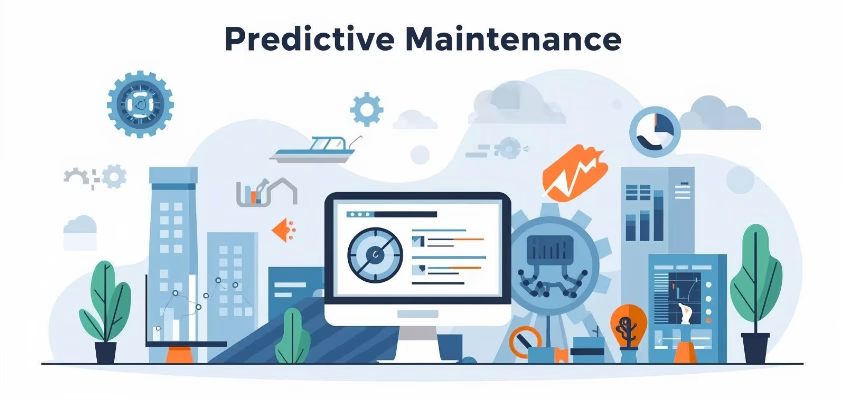
In today's intelligent world, the ability to solve problems is
Read More
Many ERP systems run processes on a daily basis that are necessary but do not add value. Employees spend valuable time manually entering orders, laboriously checking invoices or comparing documents. As a result, these repetitive tasks tie up resources that are more urgently needed elsewhere. This is precisely where Robotic Process Automation (RPA) comes in. Software robots take over these tasks, work around the clock and document every step seamlessly. Especially for medium-sized companies, RPA in combination with the existing ERP system opens up a concrete entry into automation without having to change the entire system.
Read More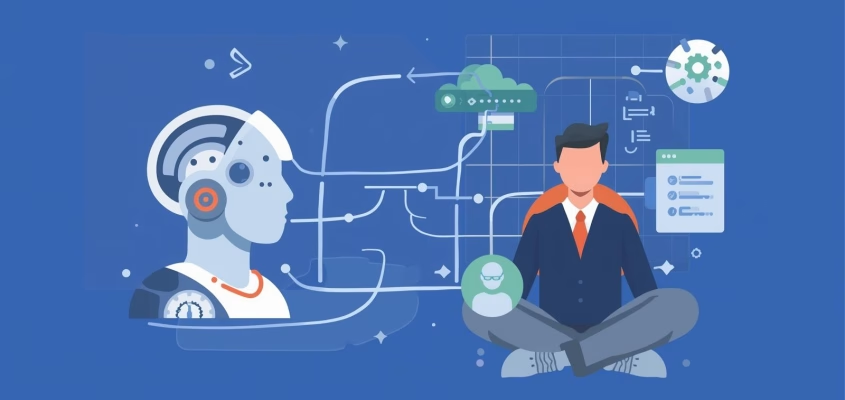
With the advent of generative AI and large language models (LLMs), the role of ERP systems is changing fundamentally. Instead of just booking transactions, storing data and delivering reports, they are evolving into interactive, learning systems. As a result, they support human decisions, accelerate processes and can even replace parts of them.
Read More